
The Tyranny of Resupply
Imagine planning the longest, most remote camping trip in human history. Now, imagine having to pack everything you'll need for years—every litre of water, every breath of air, and every meal. That's the challenge of building a Moon base. Launching materials
from Earth is incredibly expensive and logistically complex. A sustainable lunar settlement cannot rely on a constant umbilical cord to our home planet. For long-term survival 384,400 kilometres from home, astronauts can't just throw things away. Every single resource is precious, which is why the concept of a closed-loop system is not just a clever idea, but a fundamental requirement for living on another world.
Creating a Bubble of Life
So, what is a closed-loop system? In short, it’s a self-sustaining environment where waste is not waste at all—it's a resource. Think of it as creating a miniature, high-tech version of Earth's own ecosystem. On our planet, water evaporates and returns as rain, and plants convert our exhaled carbon dioxide back into oxygen. A closed-loop life support system aims to replicate these processes artificially within a lunar habitat. The goal is to purify, reclaim, and reuse everything possible. This includes water from every source, oxygen from exhaled air, and eventually, even nutrients from solid waste.
Water, Water Everywhere
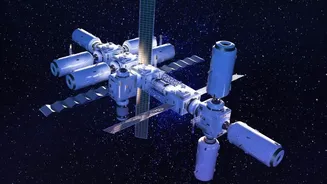
On the International Space Station (ISS), a precursor to lunar habitats, astronauts are already living on recycled water. The station’s Environmental Control and Life Support System (ECLSS) captures moisture from the crew's breath and sweat, as well as urine, and purifies it back into clean drinking water. This technology has become so effective that the water on the ISS is often cleaner than what many people drink on Earth. For a Moon base, this capability is mission-critical. Systems will be needed to process wastewater with near-perfect efficiency, ensuring that not a single drop is lost. This reduces the immense weight and cost of shipping water from Earth.
The Air We Breathe, Again and Again
Just as vital as water is breathable air. Humans exhale carbon dioxide (CO2), which is toxic in high concentrations. On the ISS, systems scrub the CO2 from the cabin air. Advanced systems, like ESA's Advanced Closed Loop System, go a step further. They use chemical processes, such as the Sabatier reaction, to split the captured CO2, recovering the oxygen atoms to regenerate breathable air. The remaining elements, like methane, might be vented or potentially used as fuel in the future. For a lunar base, these air revitalization systems will be essential, continuously turning a waste product back into the most immediate requirement for life.
Living Off the Land
True self-sufficiency on the Moon will require more than just recycling what we bring. This is where In-Situ Resource Utilization (ISRU) comes in. ISRU is the practice of harvesting and using local resources. The Moon’s soil, or regolith, is rich in oxygen, which can be extracted through heating or electrolysis. Furthermore, permanently shadowed craters at the lunar poles are believed to contain water ice. By mining this ice, a lunar base could create a local source of water for drinking, growing plants, and producing rocket fuel by splitting it into hydrogen and oxygen. This ability to 'live off the land' dramatically reduces dependence on Earth and is a crucial part of the broader closed-loop strategy.
The Final Frontier: Waste and Food
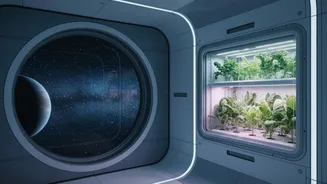
The ultimate goal of a closed-loop system is to close the loop on everything, including solid waste and food. This is the most complex challenge. Future systems envision turning inedible plant matter, packaging, and even human waste into nutrients for hydroponic farms. These lunar greenhouses would not only produce fresh food—a huge psychological and nutritional boost for astronauts—but also contribute to air and water recycling through photosynthesis. While we are not there yet, research into these advanced bio-regenerative systems is a major focus for space agencies. Success in this area will be the final piece of the puzzle, enabling a truly independent human settlement beyond Earth.