
The Cosmic Shadow Play
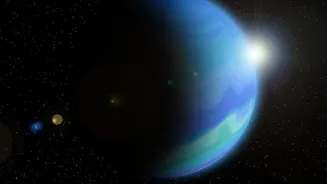
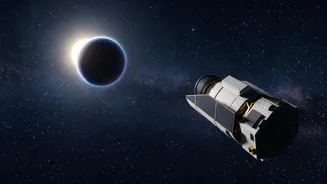
The primary technique scientists use is called transit spectroscopy. It works when a planet's orbit causes it to pass directly in front of its star from our point of view, an event known as a transit. As the planet crosses, it blocks a tiny fraction of the starlight,
causing a minuscule dip in the star's brightness that our telescopes can detect. If the planet has an atmosphere, a small amount of starlight filters through it on its way to us. This is the moment astronomers have been waiting for. The gases in the planet's atmosphere absorb specific colours, or wavelengths, of that starlight. By capturing and analyzing the light that has passed through this atmospheric layer, scientists can hunt for the missing colours.
A Telescope Built for the Task
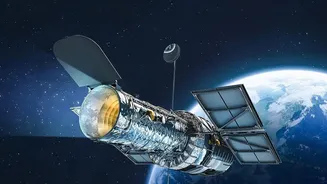
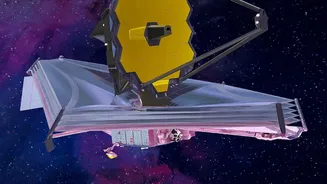
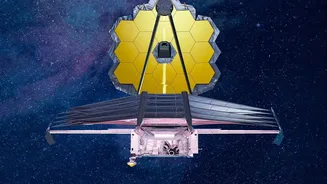
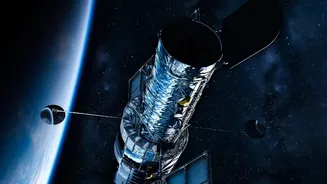
This is where advanced instruments like the James Webb Space Telescope (JWST) come in. As the most powerful space telescope ever built, JWST is exceptionally suited for this task due to its massive mirror and its sensitivity to infrared light. Many molecules, including those essential for life as we know it, leave their most distinct chemical fingerprints in the infrared part of the spectrum. When starlight passes through an exoplanet's atmosphere, these molecules absorb light at their characteristic infrared wavelengths. JWST's spectrographs can then spread this light into a rainbow, revealing the specific 'absorption lines'—dark bands where light has been soaked up by chemicals in the planet's air.
Decoding the Chemical Barcode
Each chemical element and compound has a unique spectral 'barcode'. Water, methane, and carbon dioxide all absorb light at different, predictable wavelengths. When astronomers see a dark line in the spectrum at the precise wavelength corresponding to water, for instance, they can confidently deduce its presence in the distant planet's atmosphere. The JWST has already made definitive detections of carbon dioxide and methane in the atmospheres of exoplanets like WASP-39 b and K2-18b. These detections are not just about finding individual gases; they provide crucial insights into the planet's overall composition, chemistry, and even its formation history.
The Search for Signs of Life
The ultimate goal for many in the field is to find biosignatures—gases or combinations of gases that suggest the presence of life. On Earth, for example, the abundance of oxygen is a direct result of biological activity. Scientists are looking for similar clues on other worlds. This could mean finding gases like oxygen and methane in the same atmosphere, a combination that is chemically unstable and suggests something is actively producing them. Recently, astronomers studying the exoplanet K2-18b reported tantalizing, though not yet confirmed, evidence of dimethyl sulfide (DMS), a gas that on Earth is only produced by microbial life. While these signals are incredibly faint and hard to confirm, they represent a major step forward in our ability to search for habitability beyond our solar system.
Overcoming the Challenges
This work is extraordinarily difficult. The amount of light filtering through an exoplanet's atmosphere is minuscule, making the signal incredibly faint and hard to separate from the star's own light. Clouds and haze on the exoplanet can also obscure the atmospheric layers, hiding the chemical signatures scientists are looking for. This is why repeated observations over multiple transits are often necessary to build up a strong enough signal to confirm a detection. Despite these challenges, the launch of JWST has ushered in a new era of exoplanet science, allowing for a level of detail previously unimaginable and bringing us closer than ever to understanding the nature of these distant worlds.