
Our Sun, A Turbulent Neighbour
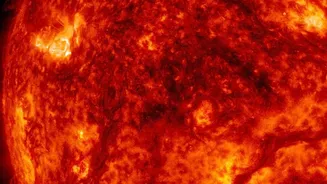
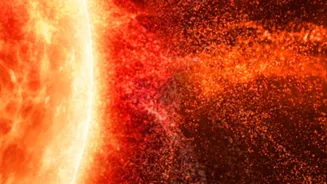
Space weather refers to the changing conditions in space, driven primarily by activity on the Sun. Much like weather on Earth, it can be calm or stormy. The Sun constantly releases a stream of charged particles called the solar wind. But sometimes, it unleashes
more violent events: solar flares, which are powerful bursts of energy, and coronal mass ejections (CMEs), which are massive eruptions of magnetised plasma hurtling through space. With the Sun currently near the peak of its activity cycle, these events have become more frequent and powerful. A recent NASA study even confirmed that the Sun has reversed a decades-long weakening trend, becoming more active and energetic since 2008.
The Unseen Disruption
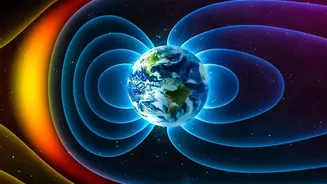
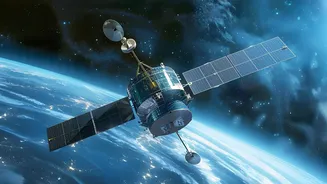
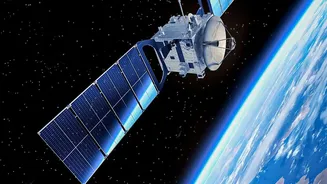
When a CME or a blast of energetic particles from a flare heads towards Earth, our planet's magnetic field deflects most of it. However, some of this energy still gets through, interacting with our upper atmosphere, particularly the layer known as the ionosphere. This interaction can cause a number of problems for the satellites we rely on. For satellites in low-Earth orbit, a geomagnetic storm can heat the upper atmosphere, causing it to expand. This increases atmospheric drag, slowing the satellites down and causing them to lose altitude, as seen in February 2022 when 38 commercial satellites were lost. For communications, the most significant effect is on the radio signals travelling between satellites and the ground.
New Research: A Stronger, More Dangerous Link
The headline of this article is inspired by very recent findings that challenge long-held assumptions. A NASA-led study published in July 2026 suggests that there may be no upper limit to the effects of extreme solar storms on Earth. For decades, scientists believed Earth's response would 'saturate' or level off during very powerful storms, but the new research argues this apparent ceiling is a statistical illusion. If confirmed, it means the most severe storms could have about twice the impact on satellites, communications, and power grids than previously estimated. This means that a 'superstorm' could be far more disruptive than current models predict, amplifying the risk to our increasingly tech-dependent society. Another mission, DAPHNE, is also being developed to better understand how weather in our lower atmosphere can amplify the effects of space weather above.
The Scintillation Effect: A GPS Nightmare
The new research deepens our understanding of a phenomenon called ionospheric scintillation. Think of it like the twinkling of stars on a clear night. Just as the Earth's atmosphere distorts starlight, irregularities in the ionosphere caused by space weather can make satellite signals fluctuate wildly in strength and phase. This can cause GPS receivers to temporarily lose their lock on a satellite, leading to significant positioning errors—sometimes by many metres. This is particularly problematic in equatorial regions like India, where scintillation activity is naturally more intense, especially in the hours after sunset. For a nation that has embraced digital payments, location-based services, and precision agriculture, ensuring the reliability of GPS and our own NavIC system is a matter of economic and national security.
Building Our Defences
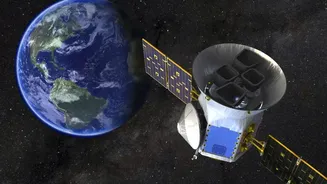
Understanding a threat is the first step to mitigating it. The new findings underscore the urgency of improving our space weather forecasting capabilities. Better forecasting gives operators more time to take protective measures, such as putting satellites into a safe mode or preparing for disruptions to power grids and communication networks. Several new missions are aimed at doing just that. The recently operational SOLAR-1 satellite can now deliver CME imagery to forecasters within 30 minutes, a massive improvement from the previous eight-hour delay. Another mission, MAGIC, set to launch in 2027, aims to provide several hours of warning time, a huge leap from the current 15 minutes. These advancements are crucial for protecting our vital infrastructure both on the ground and in orbit.