



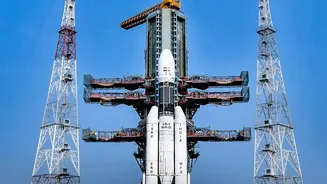
A Fundamental Shift in the Cosmos
For decades, the Indian space programme was synonymous with the Indian Space Research Organisation (ISRO). But since the sector opened up to private investment in 2020, a new ecosystem has exploded into existence. India is now home to over 450 space-tech
startups, a dramatic increase from just a handful six years ago. This boom is driven by organisations like the Indian National Space Promotion and Authorisation Centre (IN-SPACe), which was created to facilitate private participation. This has led to a surge in investment and a new wave of innovation, with companies like Skyroot Aerospace and Agnikul Cosmos developing their own launch vehicles, and firms like Pixxel building constellations of advanced earth observation satellites. This growing private industry is projected to help expand India's space economy from around $8.4 billion to $44 billion by 2033.
The Coder's Role in the Final Frontier
Modern space missions run on code. While aerospace engineers build the hardware, a growing army of software engineers builds the brains. These are not your typical IT jobs. Coders in the space sector work on highly specialized, mission-critical systems. Flight software engineers write the C++ code that runs directly on a spacecraft's on-board computer, managing everything from navigation to power systems. Ground software engineers build the complex systems used for mission control, data processing, and communication with satellites. Then there are simulation engineers, who use tools like MATLAB and Simulink to model every aspect of a mission before a single piece of hardware is built. These roles demand extreme reliability and a deep understanding of physics and engineering principles, creating a unique and challenging career path for programmers who want to build things that literally fly.
Designing for Data-Driven Decisions
As thousands of satellites beam down petabytes of data, the new challenge is making that information usable. This is where designers come in. The 'downstream' space economy is all about applications—turning raw satellite imagery and data into valuable insights for sectors like agriculture, finance, and urban planning. This has created a demand for UI/UX designers who can build intuitive platforms and dashboards that allow a farmer to monitor crop health or a city planner to track urban sprawl. These designers work at the intersection of data visualization, user experience, and domain-specific knowledge. Their job is to translate highly complex datasets into simple, actionable interfaces that don't require a PhD in astrophysics to understand, making them a crucial link in the value chain of the new space economy.
The Analyst: Turning Space Data into Earthly Intelligence
The sheer volume of data from space is creating a gold rush for data analysts and scientists. Earth observation is one of the most commercialized parts of India's space programme. Companies like SatSure and others are hiring geospatial analysts who can use GIS skills and remote sensing knowledge to analyse satellite data. These analysts build models to predict crop yields, assess drought risk, monitor infrastructure projects, and even assist in disaster management. The role requires a blend of skills: programming in Python, expertise in machine learning frameworks like TensorFlow or PyTorch, and a strong understanding of statistical analysis. They are the new astronomers, but instead of looking up at the stars, they are using data from the stars to solve problems here on Earth.
How to Get Your Foot in the Door
Breaking into the space sector no longer requires a degree in aerospace engineering. For coders, experience in C++, Python, and real-time operating systems is highly valued. Designers with a portfolio in data visualization and complex application design will find their skills are in demand. For analysts, a background in data science, GIS, and machine learning is the perfect launchpad. Many space-tech startups are actively hiring professionals from other tech sectors, valuing their experience in building scalable software products. Aspiring space professionals can look for openings at the career pages of startups like Pixxel, Skyroot, and Agnikul, or follow updates from IN-SPACe, which often highlights opportunities within the growing private ecosystem.