




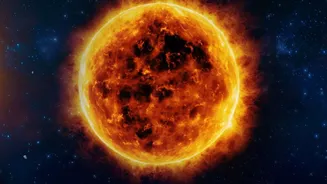
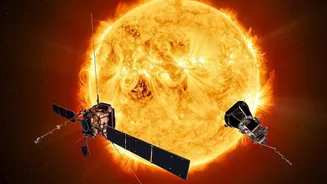
Our Sun, A Volatile Neighbour
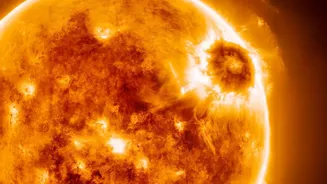
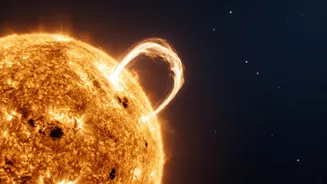
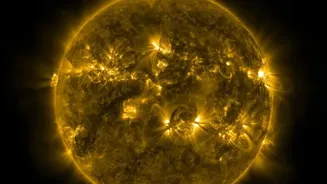
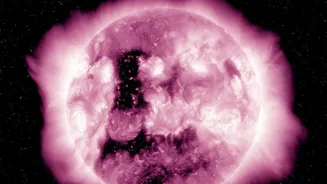
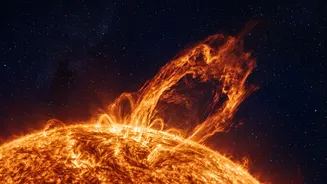
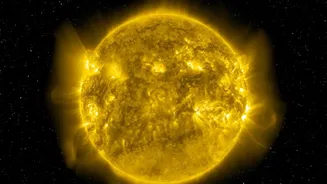
The Sun, the star that makes life on Earth possible, isn't always benign. It constantly sends out a stream of charged particles known as the solar wind. Occasionally, it unleashes massive eruptions of energy and plasma called solar flares and coronal
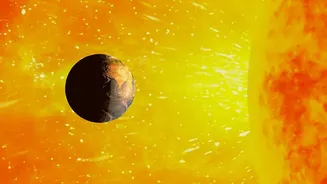
mass ejections (CMEs). When these violent eruptions are aimed at Earth, they can slam into our planet's magnetic field, triggering geomagnetic storms. While Earth's magnetosphere protects us from the worst effects, powerful storms can still induce electric currents on the planet's surface, posing a significant threat to the very technology that underpins modern society.
The Risk to Our Digital World
A severe solar storm today wouldn't just be an inconvenience; it could be catastrophic. These events can overload and damage electrical power grids, potentially leading to widespread, long-lasting blackouts. They can disrupt high-frequency radio communications used by aviation and the military, and degrade GPS signals, affecting everything from shipping to farming. Satellites, which operate outside Earth's protective atmosphere, are particularly vulnerable. The radiation can damage their electronics, while increased atmospheric drag from a storm can cause them to lose altitude and fall out of orbit. An event on the scale of the 1859 Carrington Event could cripple communications and cause trillions of dollars in damage.
Introducing DAGGER: An AI Shield
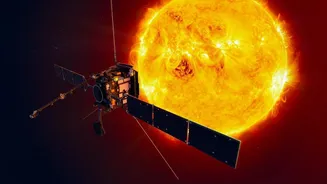
Current forecasting methods often rely on observing sunspots or provide warnings that are either too slow or not specific enough. To address this, an international team of researchers developed a new AI model called DAGGER, short for Deep Learning Geomagnetic Perturbation. Developed through a partnership including NASA, this model represents a significant leap forward. It is designed to analyse real-time data from spacecraft that monitor the solar wind and predict the specific locations on Earth where a geomagnetic disturbance will hit.
How a 30-Minute Warning Changes Everything
DAGGER's key capability is its speed and precision. Using a process called deep learning, the AI has been trained on vast amounts of satellite data to recognise the subtle connections between changes in the solar wind and their impact on Earth. This allows it to generate rapid, accurate global predictions with about 30 minutes of advance warning before the storm's effects are felt on the ground. While half an hour might not sound like much, it is a critical window of opportunity. It gives power grid operators time to take preventative measures to protect transformers, satellite operators a chance to put their spacecraft into a safe mode, and airlines the ability to reroute flights away from the most affected polar regions.
Implications for India's Future
For a rapidly digitising nation like India, reliable space weather forecasting is essential. With a growing dependence on satellite communications, digital payments, and a modernising power grid, the potential disruption from a solar storm is a major economic and security concern. The lead author of the paper on the DAGGER model is Vishal Upendran from the Inter-University Center for Astronomy and Astrophysics in India, highlighting the country's key role in this research. Early warnings from AI systems like this can help protect India's critical infrastructure and support the ambitions of its space program, ensuring its assets in orbit are safeguarded from solar threats.