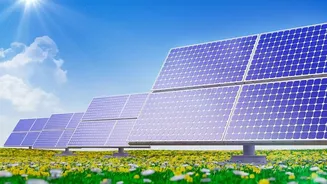







What Are Perovskite Solar Cells Anyway?
Think of solar panels, and you likely picture the familiar rigid, blue-black silicon panels on rooftops. For decades, silicon has been the industry standard. But a new contender, perovskite, is set to change the game. A perovskite isn't a brand name,
but a type of material with a specific crystal structure. What makes it so special for solar energy is its incredible ability to absorb sunlight and convert it into electricity efficiently. Unlike silicon, which requires an energy-intensive and expensive process to purify, perovskite materials can be created at low temperatures and even printed like ink from a newspaper. This simpler manufacturing process is the key to their low-cost potential. Furthermore, these cells are incredibly thin, lightweight, and can even be made flexible or semi-transparent, opening up a world of possibilities beyond rigid rooftop panels.
The Tandem Breakthrough: Better Than Silicon
The real excitement in 2026 is around 'tandem' solar cells. Scientists have discovered that by layering a thin film of perovskite on top of a traditional silicon cell, they can create a super-powered hybrid. The perovskite layer captures high-energy light (like blue and green light) that silicon struggles with, while the silicon base captures the remaining lower-energy light. This one-two punch allows tandem cells to harvest a much broader spectrum of sunlight, smashing through the theoretical efficiency limits of silicon-only panels. In late 2025, researchers achieved certified lab efficiencies of over 34%, a huge leap from the 22-24% efficiency of most commercial silicon panels today. This means a tandem panel can generate significantly more power from the same amount of space, a crucial advantage for homes with limited roof area.
From the Lab to Your Rooftop
For years, perovskite's Achilles' heel was its durability. Early versions degraded quickly when exposed to moisture and heat, making them unsuitable for the real world. However, recent breakthroughs in material engineering and advanced encapsulation are rapidly solving this problem. Companies are now developing panels with projected lifespans of over 10 years, steadily closing the gap on silicon's 25-year standard. The transition from lab to market is already beginning. Companies like UK-based Oxford PV have started shipping the first commercial-grade tandem modules. While initial production is limited and targeted at premium projects, this marks a critical milestone. In India, the potential is enormous. A recent deal saw Indian manufacturer Rayzon Solar partner with a US tech firm to produce 5 GW of high-efficiency perovskite-silicon modules in Gujarat, aiming for commercial volumes by 2028. This aligns perfectly with the 'Make in India' initiative and positions the nation as a potential leader in next-generation solar manufacturing.
What This Means for Your Electricity Bill
The ultimate goal of this technology is to make solar power dramatically cheaper. The lower manufacturing costs of perovskites could cut production expenses by nearly half compared to silicon. While a final retail price for residential panels is not yet set, the combination of higher efficiency and lower production cost points to a future of more affordable solar installations. For homeowners, this means a faster return on investment. A more efficient panel generates more electricity each day, leading to greater savings on your monthly bill and potentially allowing you to sell more surplus power back to the grid. The increased power density also means you can meet your energy needs with a smaller, and therefore cheaper, system. As this technology scales up and becomes widely available in the coming years, it promises to make solar energy a financially attractive option for a much broader segment of the Indian population, accelerating the country's transition to clean energy.