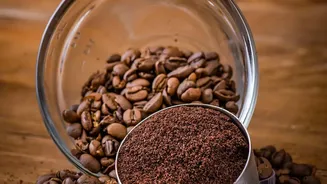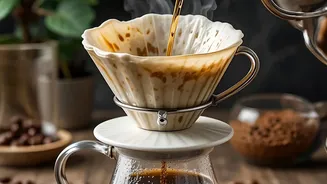



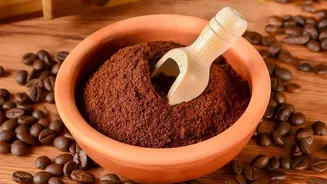
Ever wonder why your home-brewed coffee tastes different every time? The culprit is often simpler than you think. Before you blame the beans or the grinder, the secret to a consistently delicious cup begins with one basic: water measurement.
Why Ratios Rule Your Brew
Brewing coffee
is a process of extraction—pulling flavour from the ground beans into water. The single most important factor controlling this process is the coffee-to-water ratio. This balance dictates the strength and flavour profile of your final cup. Use too much water, and you'll get a thin, weak, and underdeveloped brew. Use too little, and the coffee will be overly concentrated, heavy, and likely bitter. Nailing this ratio is the foundation for unlocking the tasting notes the roaster intended, from bright and fruity to rich and chocolatey.
The Golden Ratio: A Perfect Starting Point
The specialty coffee world has a go-to starting point known as the 'golden ratio'. The Specialty Coffee Association (SCA) recommends a range between 1:15 and 1:18—that is, one part coffee to 15–18 parts water by weight. For instance, a common 1:16 ratio means using 1 gram of coffee for every 16 grams of water. For a standard 12-ounce cup, that translates to about 22 grams of coffee and 350 grams of water. Think of this not as a strict rule but as a reliable baseline. It's the ideal spot to begin your brewing journey before you start tweaking things to match your personal taste.
The Case for a Kitchen Scale
To achieve true consistency, measuring by weight is far superior to measuring by volume. A tablespoon of whole beans does not weigh the same as a tablespoon of finely ground coffee. Furthermore, the density of coffee beans varies significantly based on their origin and roast level; dark roasts are less dense than light roasts. A level scoop of a light roast from Ethiopia can weigh noticeably more than the same scoop of a dark roast from Brazil. This is why baristas rely on scales. A simple digital kitchen scale removes all the guesswork, ensuring your 20 grams of coffee is always 20 grams, leading to repeatable and predictable results every single time.
No Scale? No Problem (Mostly)
If you don't have a scale, you can still get close to the mark. A common approximation is that one level tablespoon of ground coffee is about 5-6 grams. For a standard 6-ounce cup, you would use about two tablespoons of coffee. While this method is better than simply guessing, it's inherently inconsistent due to the issues of bean density and grind size. To improve accuracy, always use a proper measuring spoon, keep it level, and use the same scoop every time. It won't be as precise as a scale, but it provides a more stable foundation than eyeballing it.
Don't Forget Water Temperature
While the ratio is key, water temperature is another critical variable. The SCA recommends a water temperature between 90°C and 96°C (195°F and 205°F). Water in this range is hot enough to efficiently extract all the desirable flavours without scorching the grounds, which can lead to bitterness. Water that is too cool will result in under-extraction, making your coffee taste sour or hollow. If you don't have a temperature-controlled kettle, a simple trick is to bring water to a full boil and then let it rest for about 30 to 45 seconds before you start pouring. This will typically land you right in the ideal temperature window.