




A New Eye on the Cosmos
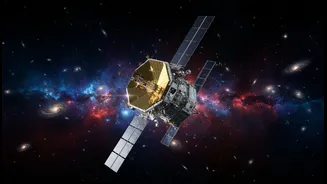
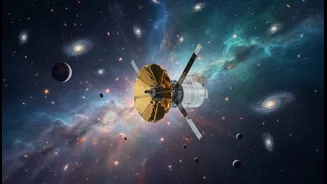
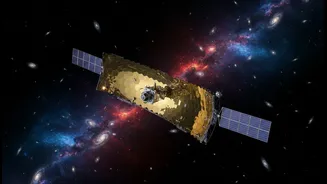
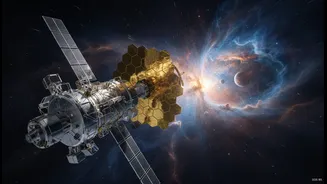
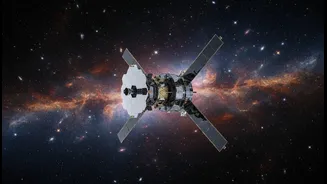
Set to launch by August 2026, the Nancy Grace Roman Space Telescope is NASA's next great observatory. While it shares a mirror size with the Hubble Space Telescope, its power lies in its extraordinary field of view. Roman can capture an image of the sky
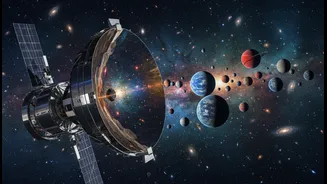
200 times larger than Hubble's infrared camera can in a single shot. This panoramic capability will allow it to map the galaxy with unprecedented speed and efficiency. While its mission includes studying the mysteries of dark energy, one of its most exciting tasks is to conduct a census of planets beyond our solar system, known as exoplanets. Scientists estimate Roman could discover a staggering 100,000 new worlds, a massive leap from the roughly 6,300 confirmed exoplanets found to date.
The Cosmic Magnifying Glass
For years, the primary method for finding exoplanets has been the "transit method," which watches for the slight dimming of a star as a planet passes in front of it. This technique is excellent for finding large planets orbiting very close to their stars. Roman will use this method, but its real game-changer is a technique called gravitational microlensing. Predicted by Albert Einstein, this phenomenon occurs when a star and its planets drift in front of a more distant star from our perspective. The gravity of the foreground star acts like a natural magnifying glass, bending and amplifying the light of the background star, causing it to temporarily brighten. If the foreground star has a planet, its own gravity creates a second, brief spike of light—a tell-tale signature of a hidden world.
Hunting for Rogue Planets
The power of microlensing is that it can find planets that are otherwise invisible to us. It is especially sensitive to planets that are farther from their stars, in orbits similar to those in our own solar system, and even planets as small as Mars. Most excitingly, microlensing is the only method capable of reliably detecting "rogue planets"—worlds that drift through the galaxy untethered to any star. These nomadic worlds emit no light of their own and don't orbit a star to block its light, making them nearly impossible to spot. But their gravity can still bend the light of a background star, creating a fleeting microlensing event. Roman’s constant monitoring of hundreds of millions of stars will be crucial for catching these brief, rare events and finally understanding how common these lonely worlds are.
Blocking a Star's Glare
In addition to its wide-field surveys, Roman is equipped with a groundbreaking technology demonstration called the Coronagraph Instrument. Trying to see a dim planet next to its bright host star is like trying to spot a firefly next to a searchlight. A coronagraph works by blocking the overwhelming glare of the star, allowing the faint, reflected light from an orbiting planet to be seen directly. The Roman Coronagraph is designed to be 100 to 1,000 times more powerful than previous space-based versions. This will allow it to take direct images of Jupiter-sized planets, a crucial step toward the ultimate goal of one day imaging Earth-like worlds with future missions like the Habitable Worlds Observatory.