

The Sleeping Giants of the Cosmos
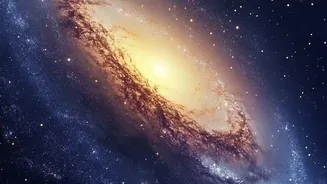
At the heart of nearly every large galaxy, including our own Milky Way, lurks a supermassive black hole—a gravitational monster millions to billions of times the mass of our sun. For the most part, these giants are quiet. They are 'dormant' because there
is nothing nearby for them to consume. Like a well-fed predator, they enter a long, inactive slumber. Most of the galaxies we see today have these quiescent black holes at their centers, their wild, formative years long behind them. Scientists believed this dormant phase was a long, stable state, a key feature in the predictable life cycle of a galaxy.
A Sudden, Violent Awakening
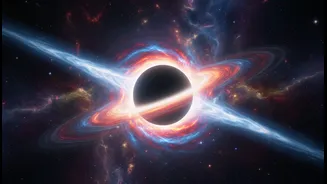
An 'awakening' happens when a black hole suddenly starts feeding again. This can be triggered by a star wandering too close and getting shredded in what's called a 'tidal disruption event', or by a sudden influx of gas and dust. When this new fuel falls toward the black hole, it forms a swirling, superheated structure called an accretion disk. This process unleashes an incredible amount of energy, causing the galaxy's core to shine brighter than all its stars combined and often launching powerful jets of plasma at near-light speed. This newly active state is known as an Active Galactic Nucleus (AGN), and witnessing one switch on is a rare event.
The Puzzling New Evidence
Recently, astronomers have been blindsided by several of these awakenings because they don't fit the established models. For example, a black hole at the center of galaxy SDSS1335+0728 began brightening dramatically in 2019 and, over four years later, is still getting brighter. This is far too long for a typical tidal disruption event, which usually fades within a few hundred days. Another event, J221951, was so intensely luminous that scientists initially mistook the distant object for a much closer stellar explosion. Then there's the case of J1007+3540, a black hole that roared back to life after 100 million years of silence, creating layered, chaotic structures that suggest its 'on-off' switch is more complex than previously thought. These events are too bright, too long-lasting, or too sudden, leaving scientists scrambling for new explanations.
Rewriting the Cosmic Clock
This puzzle has major implications for 'cosmological timelines'. The life cycles of supermassive black holes are deeply intertwined with the evolution of their host galaxies. The energy they blast out can regulate star formation, effectively shaping the galaxy around them. Astronomers use the activity levels of black holes as a kind of clock to understand a galaxy's age and history. If black holes can switch on and off more rapidly and erratically than models predict, it means our timeline for how galaxies assemble and grow may be incomplete or even incorrect. It challenges the idea that the transition from an active, chaotic youth to a quiet galactic middle-age is a one-way street.
The Hunt for Answers
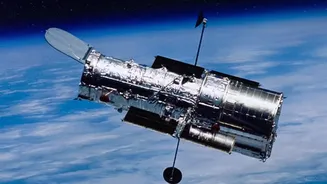
Researchers are now using a battery of advanced telescopes, from ground-based radio arrays like LOFAR and uGMRT to space-based observatories, to monitor these reawakened giants and hunt for more. They are watching these events across the entire light spectrum to understand what causes them and what they mean for the surrounding galaxy. Each new observation provides crucial data. Is it a different kind of tidal disruption event we've never seen before, or does it point to a fundamental process of AGN physics we don't yet understand? The surprising behavior of these black holes has turned them into real-time laboratories for studying the extreme physics of the universe.