




A High-Stakes Spacewalk
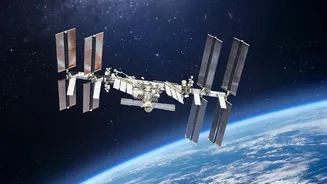
On Tuesday, August 25, 2026, NASA astronaut Anil Menon and European Space Agency (ESA) astronaut Sophie Adenot floated out of the Quest airlock to perform the 283rd spacewalk for station assembly and maintenance. The task was a continuation of a previous
outing on August 18, where the duo successfully removed a faulty Ku-band communications antenna but ran out of time to install its replacement due to the complexity of the work. This second attempt was focused on successfully bolting the new antenna into place on the station's Z1 truss segment. The spacewalk was the third for Menon and the second for Adenot, who had previously made history as the first French woman to perform an extravehicular activity (EVA).
Restoring a Vital Link
The primary goal was to replace a Space-to-Ground antenna, a key piece of hardware that enables high-speed data and video transmission between the orbital laboratory and mission control in Houston. The station has redundant systems, but the failure of one of its main antennas put pressure on the remaining links. Restoring this capability was considered essential for reliable communications. During the intricate, multi-hour operation, Menon was carefully positioned by the Canadarm2 robotic arm while both astronauts worked to secure the new unit. Ground controllers confirmed the successful installation with a call up to the crew, saying, "you just saved the video dish," highlighting the importance of the fix.
The Bigger Picture: ColKa and Beyond
While this repair focused on the main Ku-band system, it's part of a broader effort to constantly upgrade the ISS's connectivity. Another key system is the Columbus Ka-band antenna, or 'ColKa', which was installed on the European Columbus module during a previous spacewalk. The ColKa terminal provides an independent, high-bandwidth connection directly to European ground stations, using the European Data Relay System. This allows scientists in Europe to get data from their experiments almost instantaneously, rather than waiting for hard drives to be physically returned to Earth. ColKa delivers speeds up to 50 Mbit/s, similar to home broadband, and the expertise gained from it is already being applied to communications systems for the future Lunar Gateway outpost.
The Demands of Working in Space
Spacewalks, or EVAs, are among the most physically and mentally challenging tasks an astronaut can undertake. Working in a bulky, pressurized suit for over six hours requires immense concentration and physical endurance. The first attempt to replace the antenna demonstrated these challenges when the astronauts had trouble with stubborn electrical cables and bolts, consuming precious time. Every action is deliberate and often requires close coordination with both the other spacewalker and the team on the ground. After successfully installing the new antenna, Menon and Adenot also had to secure the failed unit onto a spare-parts platform, ensuring it wouldn't become a hazard. Initial tests of the new antenna showed good power and data, a testament to the crew's hard work.