

Get Your Bearings First
Before you start hunting for specific stars, the most important step is to find a good viewing spot. This means getting as far away from city lights as possible. Light pollution washes out all but the brightest objects, so a rural park or a quiet suburban
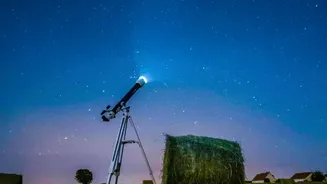
street is much better than a city centre. Give your eyes at least 20 minutes to fully adjust to the darkness; avoid looking at your phone screen, as its bright light will reset your night vision. To navigate the sky, consider using a free stargazing app like SkyView Lite or Star Walk. Simply point your phone at the sky, and the app will identify the stars, planets, and constellations you’re looking at.
Catch Two Meteor Showers
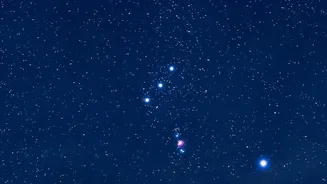
October offers two chances to see shooting stars. First up are the Draconids, which peak on the evening of October 8-9. This is an unusual shower because it's best viewed right after nightfall, not in the early morning hours. The moon will be nearly new, meaning skies will be extra dark, providing excellent viewing conditions. While the Draconids are typically a modest shower with about 5-10 meteors per hour, they have been known to produce surprising bursts of activity. Later in the month, look for the Orionids, which peak on the night of October 21-22. These meteors are debris left behind by the famous Halley's Comet. The Orionids are much faster and can produce up to 20 meteors per hour. A bright moon will interfere during the evening, but it sets after midnight, leaving the pre-dawn hours dark and perfect for meteor watching. For the best view, lie back and look at the whole sky, not just at the constellation Orion from which they appear to originate.
A Parade of Planets
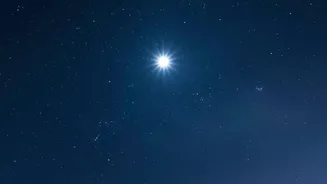
Several planets are putting on a show this month, and you won't need any special equipment to see them. Saturn reaches opposition on October 4, meaning it will be at its biggest and brightest for the year, visible all night long. Look for it as a steady, pale-yellow point of light in the southeastern sky after sunset. While you’ll need a telescope to see its famous rings, its brightness alone makes it a satisfying target for the naked eye. In the pre-dawn hours, you can spot reddish Mars and brilliant, white Jupiter in the eastern sky. Throughout the month, these two giants will appear to draw closer to each other. On the morning of October 5, a crescent Moon will appear near Mars, making for a beautiful celestial grouping.
The Hunter's Moon
October’s full moon, known as the Hunter’s Moon, rises on the evening of Sunday, October 25, reaching its peak illumination just after midnight on the East Coast, which is late Sunday night for western time zones. This full moon gets its name from agricultural traditions, as it provided bright moonlight for hunters preparing for winter after the harvest fields were cleared. The best time to watch is at moonrise, when the Moon appears largest and often takes on a beautiful orange or reddish hue due to Earth's atmosphere. This impressive size is a trick of perception known as the "Moon Illusion," but the colour is very real. Find a spot with a clear eastern horizon and watch it climb into the sky around sunset.
Spot an Iconic Star Cluster
Beyond the main events, October is a great time to spot one of the most famous star clusters: the Pleiades, also known as the Seven Sisters. To the naked eye, it looks like a tiny, misty patch of light resembling a small dipper. It's surprisingly easy to find. On the evenings of October 27 and 28, the bright Moon will pass close by the cluster, acting as a convenient guide. From some locations, the Moon will even pass directly in front of some of the stars, an event called an occultation. Even without the Moon's help, you can find the Pleiades rising in the northeast in the mid-evening, a beautiful and accessible deep-sky object that has captivated observers for millennia.