



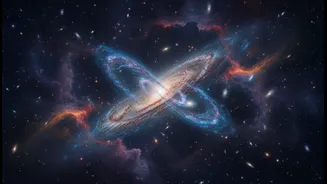


A Cosmic Nursery in Crimson and Blue
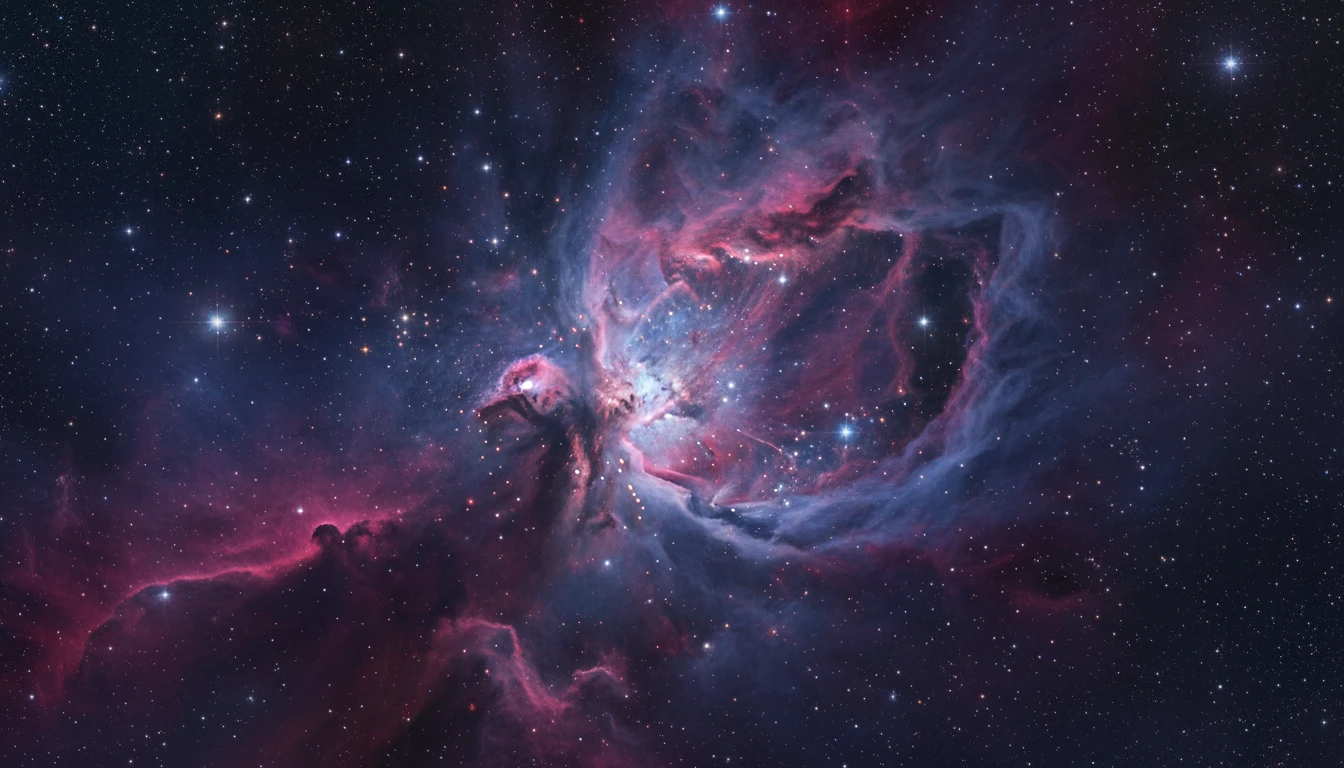
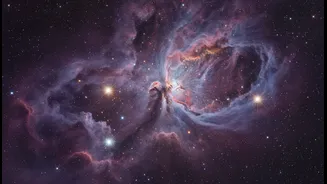
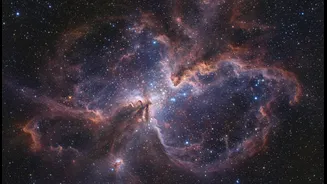
The latest celestial portrait, captured by the Hubble Space Telescope, showcases a region known as LH 95. Located in the Large Magellanic Cloud, a dwarf galaxy that orbits our own Milky Way, this image is a front-row seat to one of the universe's busiest
stellar nurseries. It presents a stunning tableau of brilliant blue and white stars sparkling against glowing crimson clouds of hydrogen gas, a scene described as resembling fireworks shining through smoke. The vibrant colours are more than just beautiful; they are scientific data points. The bright blue stars are the hottest, most massive, and most powerful objects in the region. The crimson glow comes from hydrogen gas, a telltale sign that new stars are actively being created. This provides an exceptionally clear window into a process that is often obscured by thick cosmic dust.
The Science of a Star's First Breath
Stellar nurseries, also known as molecular clouds, are immense interstellar clouds of gas and dust where stars are born. These regions are cold and dense, allowing gravity to slowly pull material together into clumps. Over millions of years, these clumps grow, and their cores become hotter and denser, forming what is known as a protostar—a baby star. The process doesn't ignite overnight. For a star to be truly born, the core temperature must reach about 15 million Kelvin. At this point, nuclear fusion begins, a process where hydrogen atoms are squeezed together to form helium, releasing an enormous amount of energy. This outward burst of energy counteracts the inward pull of gravity, creating a stable, shining star. The image of LH 95 is remarkable because it shows about 2,500 young stars that are still on this journey, yet to begin fusion.
Technology That Pierces the Veil
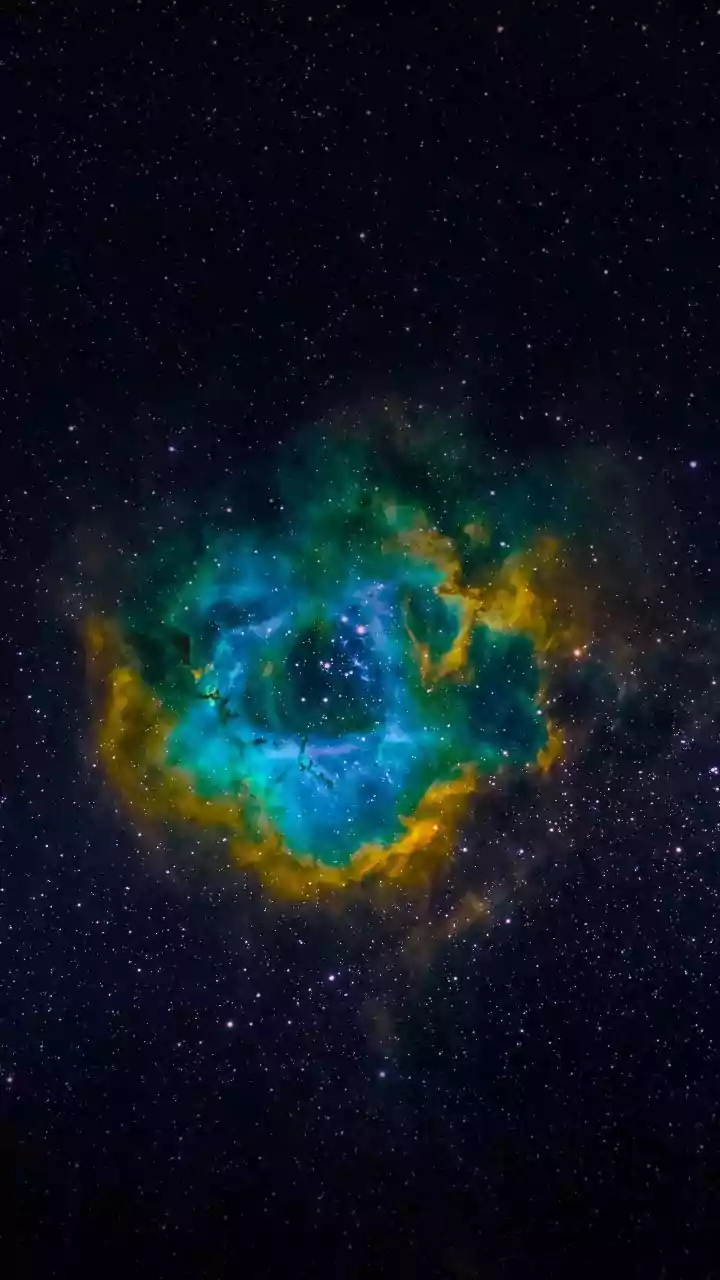
Capturing such a detailed image of stellar birth is a monumental technological achievement. While the Hubble Space Telescope provided this particular view, its work is often complemented by the infrared capabilities of the James Webb Space Telescope (JWST). Many stellar nurseries are shrouded in thick dust, which blocks visible light and hides the process from view. Infrared light, however, has a longer wavelength that can penetrate these dusty cocoons, allowing telescopes like JWST to see the hidden activity within. For the LH 95 image, astronomers used specific filters to isolate different wavelengths of light, assigning colours to reveal scientific information. Blue represents shorter, hotter wavelengths, while the prominent red highlights the hydrogen-alpha emissions associated with star formation. This technique turns invisible processes into a vibrant, understandable picture.
Why Starbirth Connects to Our Own Story
Studying the birth of distant stars isn't just an academic exercise; it's a form of cosmic archaeology that tells us about our own origins. The universe began with primarily hydrogen and helium. All the heavier elements that make up our planet, our bodies, and everything around us were forged inside stars and scattered across space when those stars died. Regions like LH 95 are active laboratories where we can watch these processes unfold. By observing young stars at different stages of development, scientists can refine their understanding of how planetary systems form from the leftover disk of gas and dust. In a very real sense, looking at a stellar nursery is like looking at a snapshot of the conditions that, billions of years ago, led to the creation of our own Sun and Earth.