



A New Look at a Familiar Neighbor
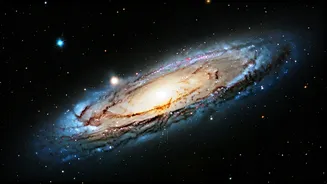
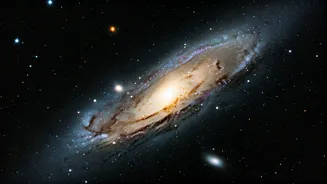
Astronomers have long been fascinated by Messier 82, a galaxy located about 12 million light-years away in the constellation Ursa Major. Known more poetically as the Cigar Galaxy, its edge-on orientation gives it a distinct, elongated shape from our vantage
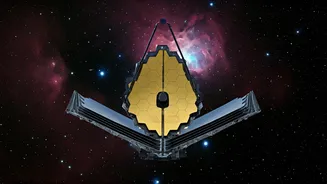
point on Earth. For decades, telescopes have pointed towards M82, capturing images of a beautiful but hazy object. It was known to be a place of intense activity, but the full picture remained shrouded in mystery, its brightest secrets hidden behind thick lanes of cosmic dust. That is, until the James Webb Space Telescope (JWST) turned its powerful gaze upon it. After an observation period totaling 65 hours, the telescope delivered an image of unprecedented clarity.
Peering Through the Cosmic Dust
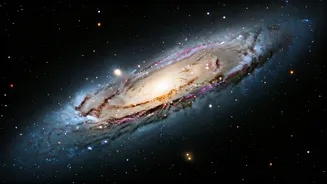
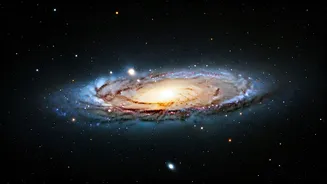
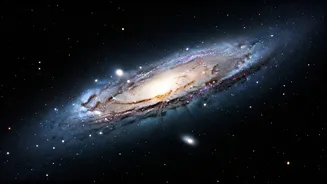
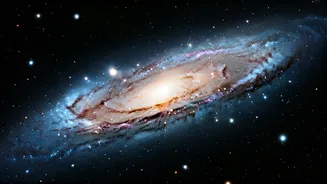
The main challenge in studying the heart of the Cigar Galaxy has always been the sheer amount of dust blocking the view. While traditional telescopes like the Hubble capture visible light, which is scattered and absorbed by dust, the JWST is designed to see in the infrared spectrum. This capability allows it to peer through obscuring cosmic clouds, much like an X-ray can see through skin. The result is a breathtakingly clear view into the galaxy's core. Where previous images showed smudges and dark lanes, Webb's new portrait reveals countless individual blue-white points of light. Each one is a star, and the final count from this new survey came to a staggering 16.5 million.
What is a Starburst Galaxy?
The reason M82 is so dusty is directly linked to why it's so interesting to scientists: it is a starburst galaxy. This means it is going through a temporary but incredibly violent phase of star formation. Stars are being born at a rate roughly ten times faster than in our own relatively calm Milky Way galaxy. All this new life comes from massive clouds of gas and dust, and the process churns up the galactic environment, creating the very dust that has hidden the action for so long. This frantic pace cannot be sustained forever. Astronomers believe this starburst phase is a fleeting moment in cosmic terms, likely to last only a few hundred million years before the galaxy settles down. Studying M82 gives us a ringside seat to one of the most dramatic events in a galaxy's life.
A Stellar Fossil Record
Being able to resolve 16.5 million individual stars is more than just a technical achievement; it provides a treasure trove of scientific data. As one scientist on the team noted, the sheer number of stars Webb resolved is incredible. This collection of stars acts as a fossil record, allowing astronomers to map out the galaxy's history. By studying the distribution and properties of these newly visible stars, scientists can better understand what triggers such intense starbursts—perhaps a past collision with a neighboring galaxy—and how they shape the evolution of the galaxy itself. As one researcher colorfully put it, “Messier 82 is a mess, but it’s a beautiful mess,” and Webb is finally helping to make sense of it.
Just a Glimpse of the True Scale
Perhaps the most mind-bending fact about this discovery is that 16.5 million is not the total number of stars in the Cigar Galaxy. It is simply the number that the JWST was able to individually distinguish in this one survey. Scientists are clear that this represents only a small fraction of the galaxy's true stellar population, with countless more stars that are too faint or still too obscured for even Webb to pick out. This realization brings the headline into sharp focus. If a census of just part of the galaxy yields a number so large it's hard to comprehend, the true scale of Messier 82 is almost beyond imagination. It makes one galaxy—one of billions in the observable universe—feel truly, incomprehensibly huge.