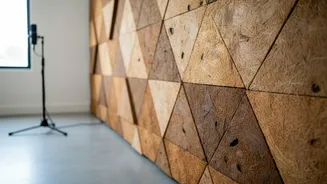








A Sound Solution to an Old Problem
In cities and homes across India, the search for peace and quiet is constant. Traditionally, achieving it has meant relying on synthetic materials like polyurethane foam or fibreglass for sound insulation. While effective, these materials come with an environmental
cost. They are often petroleum-based, non-biodegradable, and can release volatile organic compounds (VOCs). Simultaneously, the nation grapples with managing hundreds of millions of tonnes of agricultural residue annually. A groundbreaking solution is emerging at the intersection of these two issues: acoustic panels crafted from agricultural waste. These eco-friendly panels offer a sustainable way to control noise by transforming materials like rice straw, sugarcane bagasse, and coconut coir from a disposal problem into a valuable resource.
From Farm Fields to Finished Walls
The journey from a harvested field to a quiet room is a marvel of green engineering. The process begins by collecting agricultural waste products. These raw materials—be it straw, husks, or fibrous stalks—are first thoroughly dried and cleaned. They are then shredded or processed into smaller fibres and mixed with a natural, non-toxic binder. This mixture is poured into moulds and compressed under heat and pressure, forming dense, stable boards. Some advanced manufacturing techniques involve perforating the panels to enhance their sound-absorbing capabilities. The final product is a rigid, lightweight panel that is surprisingly effective at trapping sound waves within its porous, fibrous structure. One Indian company, Strawcture, is already creating these 100% bio-based composite panels, known as AgriBioPanels, to help reduce the carbon footprint of buildings.
The Eco-Friendly Advantage
The benefits of these bio-based panels extend far beyond just reducing noise. Their most significant advantage is their sustainability. By upcycling agricultural waste, they prevent it from being burned—a common practice that contributes to air pollution—or sent to landfills. Unlike their synthetic counterparts, these panels are biodegradable and have a much lower carbon footprint, as the base materials sequester carbon during their growth. They align perfectly with the principles of a circular economy, where waste is not discarded but repurposed into new, high-value products. Furthermore, because they are made from natural fibres and non-toxic binders, they contribute to healthier indoor air quality, a growing concern in modern construction.
Performance That Rivals Synthetics
A common question is whether these green materials can perform as well as their tried-and-tested synthetic competitors. Research and practical applications are providing a resounding 'yes'. Studies have shown that materials derived from agricultural waste can have excellent sound absorption coefficients, in some cases outperforming conventional synthetic absorbers. The natural porosity and fibrous structure of materials like sugarcane bagasse and coir are inherently good at trapping and dissipating sound energy. For instance, one study demonstrated that panels made from a mix of agro-waste effectively reduced noise levels by over 10 decibels. Another found that sugarcane bagasse panels with specific perforations achieved a Sound Absorption Coefficient (SAC) of up to 0.98, which is near-perfect absorption. This proves they are not just an ethical choice, but a high-performance one too.
Challenges and the Road Ahead
Despite their immense potential, plant-based acoustic panels are not yet the industry standard. The primary challenges include scaling up production to compete with the massive and established synthetic foam industry. Ensuring consistency in quality when dealing with variable natural materials can also be a hurdle for manufacturers. Another factor is market awareness; architects, builders, and consumers need to be educated about the benefits and long-term value of these sustainable alternatives. However, as demand for green building materials grows and regulations around sustainability become stricter, the tide is beginning to turn. The initial cost might be a consideration, but as production scales, prices are expected to become more competitive, especially when factoring in the long-term environmental and health benefits. The journey from niche innovation to mainstream material is underway, driven by a new consciousness in construction and design.