
A Sweet Discovery in Fallen Rocks
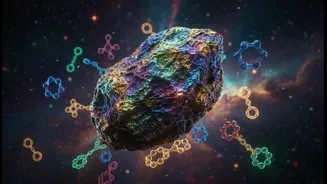
In recent years, researchers analysing carbon-rich meteorites, such as the famous Murchison meteorite that landed in Australia, made a landmark discovery. Tucked inside this ancient space rock, they found traces of bio-essential sugars. These weren’t
just any sugars; they identified ribose, a critical component of life as we know it. For years, scientists had wondered if the building blocks of life could have been delivered to a young Earth from the cosmos. They had already found other key ingredients like amino acids, which form proteins, and nucleobases, which make up the 'rungs' of the DNA ladder. But sugars, a fundamental part of the recipe, remained a missing piece of the puzzle until now. The discovery provided the first direct evidence that a sugar crucial for life existed in outer space and could have survived a fiery descent to Earth.
The Blueprint for an 'RNA World'
The discovery of ribose is especially exciting because it’s the structural backbone of ribonucleic acid, or RNA. In modern biology, RNA acts as a messenger, carrying instructions from DNA to the protein-building machinery within our cells. However, many scientists support the 'RNA World' hypothesis, a theory suggesting that RNA came before DNA in the story of life. This is because RNA is a versatile multi-tasker; it can store genetic information like DNA and can also act as an enzyme to drive chemical reactions, a role now primarily filled by proteins. The findings from the meteorites add significant weight to this theory. While researchers found ribose, they did not detect 2-deoxyribose, the sugar that forms the backbone of DNA. This suggests that meteorites may have selectively delivered ribose to the early Earth, creating an environment where RNA-based life could flourish long before the more stable, double-helix structure of DNA evolved.
Confirming the Cosmic Delivery Service
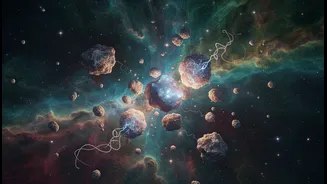
One challenge with studying meteorites is the risk of contamination from Earth's own biology. However, recent missions have provided even stronger evidence. Japan's Hayabusa2 and NASA's OSIRIS-REx missions successfully collected pristine samples from asteroids Ryugu and Bennu and returned them to Earth in contamination-free capsules. Analysis of these samples confirmed the presence of not only nucleobases but also bio-essential sugars like ribose. Finding these compounds in untouched material straight from an asteroid reinforces the idea that these molecules formed in space. The theory, sometimes called 'panspermia' or prebiotic delivery, suggests that a constant bombardment of asteroids and comets during Earth's early history seeded our planet with the raw materials necessary for life to emerge from non-biological chemistry. These missions prove the ingredients were out there, waiting to be delivered.
Beyond Our Solar System
The story doesn't end with meteorites. In a more recent and perhaps even more profound discovery, astronomers detected a 'true sugar' molecule for the first time in the vast, cold expanse of interstellar space—the gas and dust clouds that exist between stars. While not ribose, the discovery of a complex sugar like erythrulose in a molecular cloud near the centre of our galaxy shows that the chemical processes that create these molecules are not unique to asteroids in our solar system. They are a common feature of the galaxy. This implies that the chemical building blocks for life are widespread throughout the cosmos. If these ingredients are being cooked up in stellar nurseries across the Milky Way, then the potential for life to emerge on other planets orbiting other stars becomes a much more plausible and exciting possibility.