




A New Look at Alien Skies
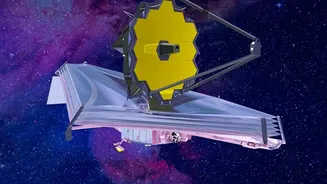
The James Webb Space Telescope is providing the best evidence to date for atmospheres around rocky, Earth-like planets in other star systems. One prominent example is the super-Earth known as 55 Cancri e, located 41 light-years away. Using its powerful
infrared instruments, Webb detected gases that are likely carbon monoxide or carbon dioxide. This is a landmark moment; while atmospheres around gas giants have been studied for years, getting a clear signal from a smaller, denser rocky world has been a major challenge. The telescope works by analyzing starlight that filters through a planet's atmosphere during a transit—when the planet passes in front of its star. Different gases absorb specific wavelengths of light, leaving a chemical fingerprint that Webb's spectrographs can read. The data from 55 Cancri e points not to a barren rock, but to a world wrapped in a substantial, carbon-rich blanket.
The Case of a Molten World
The planet 55 Cancri e is no paradise. It orbits its star so closely that its surface is likely a scorching ocean of molten magma. Initially, scientists were unsure if the signals Webb detected were from a true atmosphere or just a thin shroud of vaporized rock. However, the planet’s dayside temperature was found to be around 1540 degrees Celsius, significantly cooler than the 2200 degrees that would be expected if it were just bare, dark molten rock. This temperature difference suggests an atmosphere is present and circulating heat around the planet. Scientists now believe this carbon-rich atmosphere is not a remnant from the planet's formation but is actively being supplied by the vast magma ocean itself, which continuously releases dissolved gases from the planet’s interior. This creates a dynamic interplay between the molten surface and the air above it.
Rethinking the 'Habitable Zone'
For decades, the search for life has focused on the “Goldilocks Zone” — the orbital range where a planet is not too hot and not too cold for liquid water to exist on its surface. This model is based on Earth, where liquid water is the fundamental ingredient for life as we know it. However, the discovery of a stable, carbon-heavy atmosphere on a world as extreme as 55 Cancri e challenges these assumptions. It suggests that a planet's geology and volcanic activity can create and sustain an atmosphere even under intense stellar radiation. While 55 Cancri e itself is far too hot to be considered habitable, its existence proves that rocky planets can hold onto significant atmospheres outside the traditional habitable zone. This forces scientists to consider that the building blocks for life might exist on worlds with very different conditions from Earth, possibly with atmospheres dominated by carbon compounds rather than nitrogen and oxygen.
What This Means for the Search for Life
This discovery doesn't mean we've found aliens, but it dramatically broadens the types of planets that astronomers will target in the search for life. It shifts the focus from just finding water to understanding the full planetary system, including its atmospheric composition and geological activity. Future JWST observations will target other rocky worlds, including those in the famous TRAPPIST-1 system, to see if they too have atmospheres and what they are made of. Some models suggest these findings could provide crucial insights into the early conditions of planets in our own solar system, like Earth, Venus, and Mars, when they were young and volcanically active. The presence of carbon dioxide and methane together, for example, is one potential biosignature, as life can produce both. However, interpreting these signs is complex, and scientists must rule out non-biological sources first.