








The Ultimate High Ground for Earth
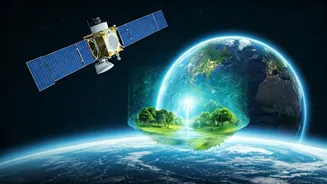
The most immediate and impactful way space serves sustainability is through its unique vantage point. A constellation of Earth-observation satellites acts as our planet's health monitor, providing invaluable data on a global scale. In India, ISRO’s fleet,
including the Cartosat and Resourcesat series, provides high-resolution imagery crucial for managing our natural resources. These orbital eyes can track deforestation in near real-time, monitor the health of crops to ensure food security, map the retreat of glaciers, and identify sources of air and water pollution with pinpoint accuracy. This data is no longer just for scientists; it’s a critical tool for governments, businesses, and environmental agencies to make informed decisions, enforce environmental laws, and respond to natural disasters more effectively. Without this view from above, our understanding of climate change would be a blurry sketch instead of the high-definition picture we have today.
Powering the Planet from Orbit
One of the most ambitious ideas in this partnership is Space-Based Solar Power (SBSP). The concept sounds like science fiction: giant solar panels in orbit that capture sunlight 24/7, unhindered by weather or nighttime. This energy is then converted into microwaves and beamed down to receiving stations on Earth, where it’s converted back into electricity. While the engineering challenges are immense, the potential payoff is a source of clean, continuous, and virtually limitless energy. Nations like China, the US, and Japan are actively researching the technology. The goal is to overcome hurdles like the cost of launching heavy components and ensuring the safe transmission of energy. If successful, SBSP could revolutionise our energy grid, drastically reducing our reliance on fossil fuels and providing a foundational power source for a truly sustainable global economy.
Lessons in Living Lean
Living in space is the ultimate exercise in resource management. On the International Space Station (ISS), nothing is wasted. Astronauts rely on advanced closed-loop life support systems that recycle over 90% of the water from sources like sweat and urine, and scrub carbon dioxide from the air to produce oxygen. These are not just clever space gadgets; they are blueprints for sustainable living on Earth. The principles and technologies behind them are inspiring innovations in water purification for arid regions, advanced air filtration systems for polluted cities, and hyper-efficient vertical farming techniques that use less water and land. The extreme constraints of space force a level of ingenuity that has direct applications for tackling resource scarcity and waste management back home, proving that solutions for survival off-world can help us thrive on-world.
The Quest for Greener Rockets
The space industry is also confronting its own environmental footprint. Traditional rocket launches burn massive amounts of carbon-based fuels, releasing pollutants into the atmosphere. Recognising this, a new race is underway to develop more sustainable propulsion methods. Companies are experimenting with cleaner-burning fuels like methane, which is more efficient and produces less soot than kerosene. The holy grail is green hydrogen, which produces only water vapour as a byproduct. While significant technical challenges remain in storing and handling these cryogenic fuels, the push towards “green launch” systems shows a growing industry-wide commitment to ensuring that our journey to the stars doesn't come at an unacceptable cost to our home planet. This shift is not just ethical, but also economic, as sustainability becomes a key metric for investors and clients in the burgeoning space economy.