

Decoding a Planet's Atmosphere
Spectrum analysis is a foundational tool in astronomy that allows scientists to determine the chemical composition of distant objects. At its core, the technique involves breaking down light into its constituent colours, or wavelengths, much like a prism
splits sunlight into a rainbow. Every chemical element and compound absorbs and emits light at a unique set of specific wavelengths. When starlight passes through an exoplanet's atmosphere, gases like water vapour, methane, or carbon dioxide absorb some of that light, leaving behind a distinct pattern of dark lines in the star's spectrum. This pattern acts like a chemical 'barcode' or 'fingerprint', telling astronomers exactly what is present in that alien atmosphere.
The Transit Technique
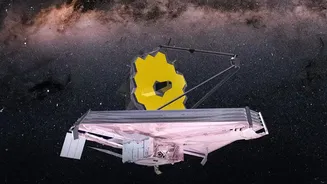
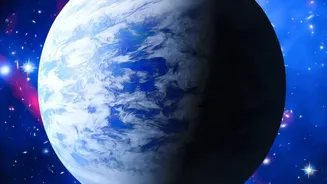
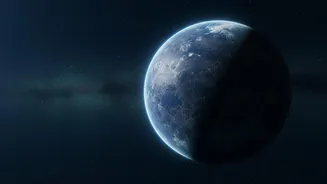
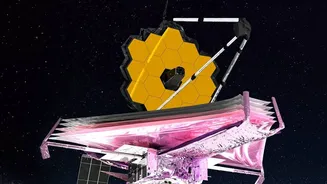
To get this atmospheric fingerprint from a planet hundreds of light-years away, astronomers rely on an event called a transit. This occurs when an exoplanet passes directly in front of its host star from our point of view. As the planet transits, a tiny fraction of the starlight is filtered through its atmosphere before it reaches our telescopes. By capturing the spectrum of the star just before and during the transit, scientists can subtract one from the other. The difference reveals the absorption lines created exclusively by the planet's atmosphere. This method, known as transmission spectroscopy, is our most powerful tool for characterising the atmospheres of these distant worlds, especially with the advanced capabilities of instruments like the James Webb Space Telescope (JWST).
The Hunt for Water on Rocky Worlds
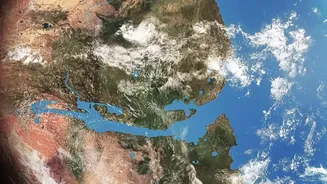
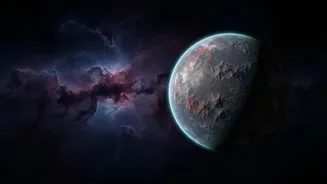
While water vapour has been detected in the atmospheres of many large, gassy 'hot Jupiters', finding it on smaller, rocky planets is a much greater challenge and a more exciting prospect. These planets are smaller, meaning their atmospheres are much thinner and the signal they produce is fainter—often just a few parts per million of the starlight. Despite the difficulty, recent observations have yielded tantalising results. The JWST has detected signs of water vapour in the atmospheres of some rocky exoplanets. For example, hints of water were found around GJ 486 b, though scientists are still debating if the signal comes from a planetary atmosphere or the star itself. In another first, Webb also detected water vapour in the inner, rocky-planet-forming zone of a young star system, PDS 70, suggesting that the ingredients for habitable worlds are present from the very beginning.
Challenges and the Power of JWST
Detecting these faint signals is incredibly difficult. Stellar activity, like starspots, can mimic the signature of an atmosphere, creating false positives that scientists must carefully rule out. Furthermore, impenetrable clouds can block starlight, hiding the atmospheric layers below and leaving a featureless spectrum. This is where the unprecedented power of the James Webb Space Telescope comes in. Its massive mirror and sensitivity to infrared light—where molecules like water have strong spectral features—allow it to capture data with far greater precision than ever before. JWST has already provided the most detailed transmission spectra of rocky planets to date, even if a definitive, thick atmosphere has not yet been confirmed on a temperate, Earth-like world.