
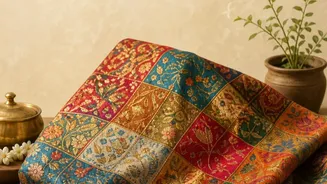
Long before 'upcycling' became a buzzword, women across India were turning worn-out fabrics into objects of comfort and beauty. These handmade quilts are more than just blankets; they are stitched diaries of family life and resourcefulness.
A Philosophy of Love and Frugality
Across the
diverse cultural landscape of India, a common thread of practicality and affection is woven into the tradition of quilting. Born not from abundance but from necessity, these crafts transform old, soft, and memory-laden fabrics—worn-out saris, dhotis, and children's clothes—into multi-layered blankets. This practice is the ultimate form of sustainable living, ensuring nothing goes to waste. But more than just being eco-friendly, it is an act of love. Quilts made from a mother's or grandmother's sari carry their scent and stories, providing comfort that transcends mere warmth. Each stitch reinforces the fabric and embeds a new layer of family history, creating a keepsake to be passed down through generations.
Godhadi: Stitches of Maharashtra
In Maharashtra, the tradition is known as Godhadi. These quilts are made by layering old pieces of cloth and stitching them together with a simple, strong running stitch. Traditionally, women in a village would gather in the afternoons, especially during seasons with less farm work, turning the quilting process into a communal event filled with stories and songs. A Godhadi is purely functional, designed for warmth, but its creation is an art form. The arrangement of colourful fabric scraps can be a simple patchwork or an intricate mosaic, turning discarded textiles into a vibrant canvas that tells the story of the family who wore them.
Kawandi: The Siddi Community's Patchwork
In the northern parts of Karnataka, the Siddi community, descendants of early migrants from East Africa, practice a unique form of quilting called Kawandi. Unlike other methods where quilts are pieced together first, a Kawandi is built from the outside edges inward, directly onto the backing fabric. Scraps of cloth are tucked and appliquéd, and the entire quilt is held together with visible, rhythmic stitches. This technique is often improvisational, allowing the design to grow organically. Traditionally made by women for their families, these quilts might have decorative triangular patches called 'phula' (flowers) at the corners, and were made entirely from recycled clothing.
Sujani: From Birth Ritual to Social Narrative
The Sujani tradition of Bihar has a fascinating history. The name itself comes from 'su' (easy) and 'jani' (birth), as the first Sujanis were soft quilts made by layering old saris and dhotis to wrap newborn babies. Women would embroider these quilts with their hopes and dreams for the child, using motifs like the sun to represent life or animals to offer protection. Over time, Sujani evolved from a purely ritualistic craft into a powerful medium for storytelling and social commentary. In the late 20th century, the craft was revived, and artisans began using their needles to depict scenes of village life, women's empowerment, and social issues on wall hangings and other textiles, transforming the humble quilt into a canvas for advocacy.
Kantha: The Running Stitch of Bengal
Kantha from West Bengal and Bangladesh is perhaps one of the most well-known Indian quilting traditions. The word itself is believed to mean 'rags' in Sanskrit. The craft involves layering old fabrics and using a simple running stitch to create intricate patterns and narratives. Originally used to make simple quilts, Kantha embroidery evolved to include detailed motifs from mythology, nature, and daily life. Though the craft saw a decline with the rise of industrial textiles, it was revived in the 20th century and is now a celebrated art form, empowering rural women artisans who create everything from quilts to contemporary apparel.