





2001: A Space Odyssey (1968)
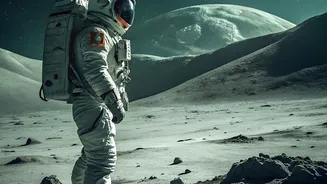
More than half a century after its release, Stanley Kubrick's masterpiece remains a benchmark for cinematic space travel. Long before the advent of modern computer-generated imagery, Kubrick and his team, including special effects pioneer Douglas Trumbull,
created a vision of space so realistic it still feels flawless. The film pioneered groundbreaking practical effects, such as a massive, rotating centrifuge set to simulate gravity and the mind-bending 'Stargate' sequence, achieved through an innovative technique called slit-scan photography. Kubrick insisted on a level of realism that was unprecedented, using high-resolution front projection and meticulously detailed models to create a tangible, awe-inspiring journey to Jupiter and beyond. By treating space with such reverence and visual precision, 2001 set a new standard, proving that science fiction could be both a philosophical exploration and a stunning visual spectacle. Its influence is seen in nearly every major space film that followed.
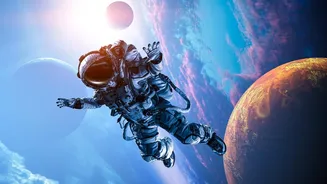
Gravity (2013)
Alfonso Cuarón’s survival thriller is less a movie about space and more a movie that happens entirely within it, creating a visceral and claustrophobic experience. The film is celebrated for its groundbreaking cinematography, which makes the audience feel as if they are right there with the astronauts, adrift in the silent, deadly vacuum after their shuttle is destroyed. 'Gravity' pushed the boundaries of visual effects to create long, unbroken shots that seamlessly blend live-action performances with a completely digital environment. The result is a breathtaking depiction of zero-gravity physics, where every floating object, every shard of debris, and every desperate movement feels terrifyingly real. It's a masterclass in immersive filmmaking, designed to be seen on the largest screen possible to fully appreciate the terrifying beauty and immense scale of Earth as seen from orbit. The film is a pure, distilled cinematic experience about the perils of space exploration.
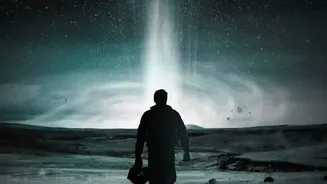
Interstellar (2014)
Christopher Nolan’s epic is a modern swing at the same ambitious scale as 2001, blending a deeply emotional human story with a scientifically rigorous depiction of space travel. To create the film's stunning visuals, especially the black hole Gargantua, Nolan's team collaborated with theoretical physicist Kip Thorne. They translated Thorne's complex equations into a custom renderer, resulting in what is considered the first scientifically accurate visualization of a black hole and its gravitational lensing effect in a Hollywood movie. This dedication to science led to new discoveries about black holes that were later published in scientific papers. Shot on stunning 65mm IMAX film, 'Interstellar' was explicitly designed for the giant screen, creating an immersive sense of realism whether the characters are traversing a wormhole, exploring alien worlds, or orbiting the swirling, fiery accretion disk of Gargantua.
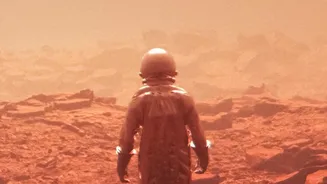
The Martian (2015)
Ridley Scott's adaptation of Andy Weir's novel is a story of survival grounded in scientific problem-solving. While the science is the star, the film's visual effects are crucial in bringing the desolate beauty of Mars to life. The production team used a combination of practical locations and digital creations. Many scenes were filmed on massive soundstages in Budapest against greenscreens, but the vast exterior shots of the Martian landscape were filmed in Jordan's Wadi Rum desert, a location so fitting it has been used for multiple Mars-set films. The visual effects team then masterfully blended these elements, creating a seamless and believable Red Planet. Nominated for an Academy Award for its visual effects, the film meticulously crafted every detail, from the CG-heavy Hermes spacecraft to the reflections in the astronauts' visors, which often had to be digitally replaced to remove the film crew's reflection.