


A Visitor From Beyond Our Solar System
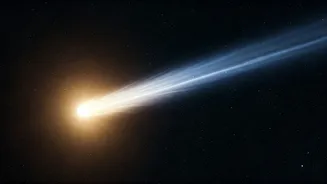
On July 1, 2025, an automated telescope in Chile, part of the Asteroid Terrestrial-impact Last Alert System (ATLAS), spotted something new. It was a faint object moving with incredible speed. Astronomers quickly calculated its path and realised it wasn't
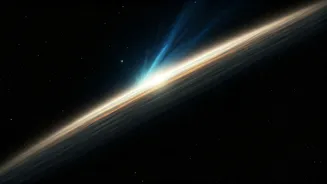
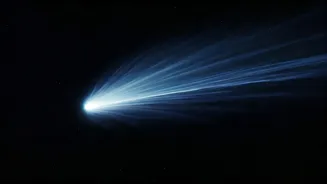
making a gentle loop around our Sun. Instead, it was on a hyperbolic trajectory—a path that meant it came from deep space, would swing past our Sun once, and then leave forever. This confirmed it was an interstellar object: a visitor not gravitationally bound to our star. It was officially named 3I/ATLAS, with the '3I' designating it as the third interstellar object ever discovered. The 'ATLAS' honours the survey that found it. Unlike everything else native to our solar system, 3I/ATLAS is a true outsider, a remnant from a planetary system far, far away.
Not the First, But Radically Different
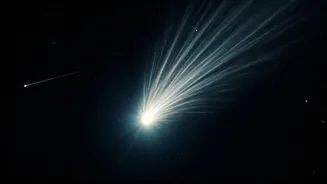
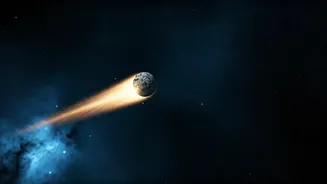
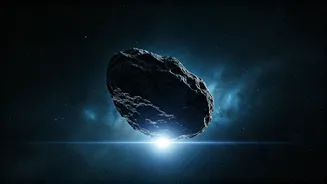
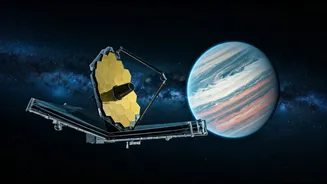
While 3I/ATLAS is a rare guest, it's not our first. In 2017, astronomers spotted 1I/ʻOumuamua, a bizarre, cigar-shaped object that showed no cometary activity. Its unusual shape and movement sparked intense debate. Then, in 2019, came 2I/Borisov, discovered by an amateur astronomer. Borisov looked and acted much more like a conventional comet, complete with a fuzzy coma of gas and dust. 3I/ATLAS makes for a fascinating third data point. It is an active comet, similar to Borisov, but early studies have revealed a unique chemical signature. Observations from the James Webb Space Telescope show it has an exceptionally high amount of deuterium, or 'heavy water', suggesting it formed in a very cold environment, perhaps even before our own Sun existed. Each new visitor provides another piece of the puzzle, helping scientists understand the diversity of objects that roam the galaxy.
Why This Cosmic Relic Matters
Studying interstellar objects is about more than just satisfying curiosity. These visitors are time capsules from other star systems. Because they are leftovers from the planet-formation process, their chemical makeup provides a direct sample of the raw materials that build alien worlds. For instance, the chemistry of 3I/ATLAS suggests it may be older than our entire solar system, originating from a star that formed in the galaxy's ancient 'thick disk'. By analysing the gas and dust it releases as it nears our Sun, scientists can learn about the conditions around its parent star. This is the closest we can get to studying an exoplanetary system up close without actually sending a probe across light-years of space. Each observation gives us a clearer picture of whether our solar system's ingredients are common or rare in the grand scheme of the Milky Way.
Joining the Cosmic Conversation
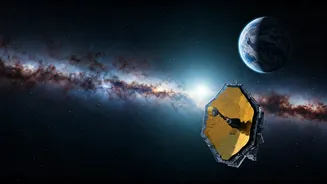
3I/ATLAS made its closest approach to the Sun in late October 2025 and is now on its way out of the solar system, never to return. But its departure doesn't mean the science is over. Astronomers scrambled to observe it with every tool available, from ground-based telescopes to space-based observatories like Hubble and JWST. The data collected during its brief pass will be analysed for years to come, generating new insights into its origin and composition. For science enthusiasts, following these discoveries is like tuning into a cosmic conversation. Modern sky surveys like the Vera C. Rubin Observatory are expected to find many more interstellar objects in the coming years. Each one will add to our knowledge, revealing more about the galaxy we call home. Spotting these objects is incredibly difficult; they are small, faint, and moving fast. But each successful detection is a testament to technological progress and a chance to glimpse a true piece of the cosmos from beyond.