



A Tale of Two Planets
On Earth, wind easily picks up and moves sand grains. Our relatively thick atmosphere provides enough force to get the particles hopping and build the familiar ripples and dunes we see in deserts. On Mars, the story is completely different. The Martian
atmosphere is incredibly thin—less than 1% the density of Earth's. This means that even very high-speed winds struggle to move sand. A 40-mile-per-hour gust on Mars might feel like a gentle breeze. However, Mars has a secret weapon: its gravity is only about one-third of Earth's. This lower gravitational pull makes it easier for wind to lift sand grains once they get moving, creating a complex interplay between a weak wind and easily airborne sand. This fundamental difference sets the stage for landforms that can’t exist on our home planet.
The Riddle of the Ripples
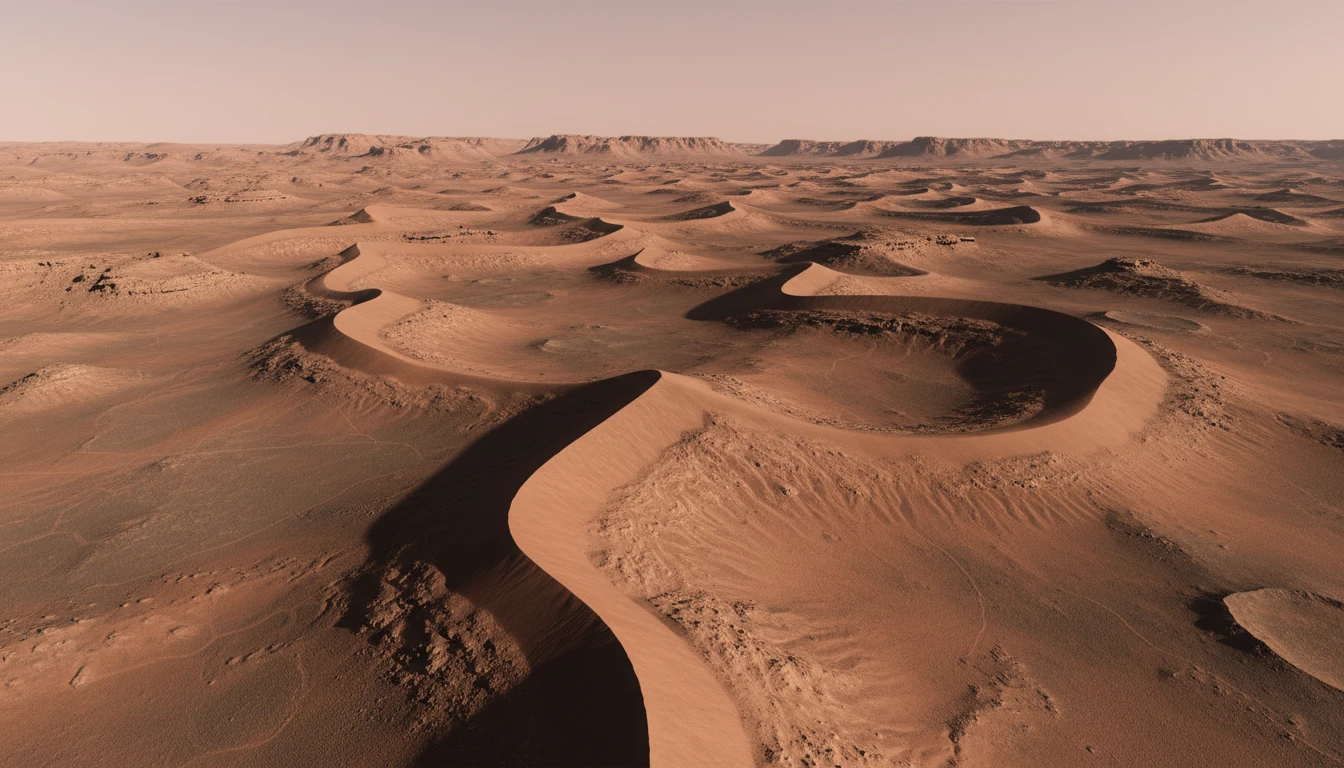
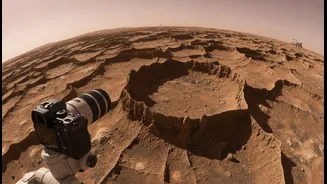
For years, images from Martian orbiters and rovers showed a perplexing sight: two distinct sizes of sand ripples often appearing together. One type looked like the small, inch-spaced ripples common on Earth, known as 'impact ripples,' formed by bouncing sand grains splashing into a sandy surface. But alongside them were much larger ripples, spaced about 10 feet apart. These were too small to be classified as dunes but far larger than any impact ripples seen on Earth. This unique, intermediate-sized feature became a major Martian mystery. Scientists were unsure if they were just overgrown versions of the smaller ripples or something else entirely. Close-up observations from NASA's Curiosity rover finally provided the answer: the smaller ripples were indeed standard impact ripples, but the larger ones were a completely new type of structure.
Introducing 'Wind-Drag Ripples'
Researchers now believe these mysterious larger ripples form through a process similar to how flowing water creates ripples in a riverbed on Earth. Dubbed 'wind-drag ripples,' they are shaped directly by the drag of the Martian wind itself, not by the splashing of sand grains. This can happen on Mars because the extremely thin atmosphere behaves more like a fluid in this context. The size of these wind-drag ripples is directly related to the density of the atmosphere moving the grains. On Earth, our thick atmosphere prevents this kind of ripple from forming with sand. You need a denser fluid, like water, to do it. The coexistence of both impact ripples and these larger wind-drag ripples is a uniquely Martian phenomenon, a direct consequence of its low-density atmosphere.
Slow-Moving Giants
While ripples tell one part of the story, the massive dunes they cover tell another. Martian dunes move, but they do so with incredible slowness. Studies have found that while a fast-moving dune on Earth can migrate 100 feet in a year, a typical Martian dune creeps along at just two feet per year. There simply isn't enough wind energy to move large amounts of material quickly. This sluggish pace led some scientists to wonder if the dunes were static relics from a time when Mars had a thicker atmosphere. However, detailed tracking has confirmed they are active today, reshaped by winds generated by seasonal changes, such as the thawing of the polar carbon dioxide ice caps. The most active dune fields are found in areas with dramatic changes in topography and surface temperature, factors that have little effect on Earthly dunes.
Clues to a Lost Atmosphere
Understanding these unique sand patterns is more than just a geological curiosity. Because the size of wind-drag ripples is tied to atmospheric density, they serve as a historical record. By studying fossilized ripples preserved in ancient Martian sandstone, scientists can reconstruct what the planet's atmosphere was like billions of years ago. Analysis of 3.7-billion-year-old rock formations has revealed evidence of these same large ripples, suggesting Mars has had a thin atmosphere for a very long time. These sandy features are a key tool in piecing together the timeline of how, when, and why Mars lost most of its atmosphere, transforming from a potentially habitable world to the cold desert we see today.