

See the Moon Meet the Planets
Throughout the first half of September, the Moon will appear to pass close to several planets, offering a fantastic and easy way to identify our neighbours in the solar system. On the mornings of September 6 and 7, look for the crescent Moon near a faint
Mars in the eastern sky before dawn, around 3 a.m.. Just a day later, on September 8, the Moon will be near the much brighter Jupiter, also in the pre-dawn hours. These close approaches, called conjunctions, are excellent opportunities for beginners because the Moon acts as a giant signpost. If you have binoculars, they will make the view even better, but these events are easily visible with just your eyes.
Enjoy Dark Skies with the New Moon
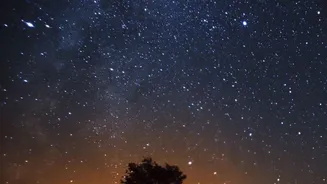
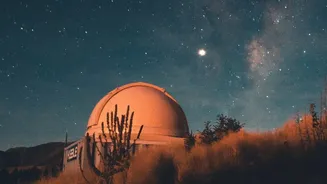
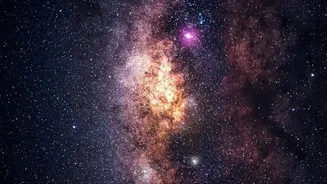
One of the best times for stargazing is around the New Moon, when the sky is at its darkest because there is no bright moonlight to wash out fainter objects. This month, the New Moon falls on September 11-12. This is an ideal time to head to a location with less city light pollution. From a dark spot, you can get a breathtaking view of the Milky Way's core, which is still visible in the Northern Hemisphere this month. Places like Ladakh, with India's first Dark Sky Reserve, or the Rann of Kutch offer world-class viewing conditions. Even a short drive away from city lights can dramatically improve your view of thousands of stars, constellations, and the hazy band of our home galaxy.
Spot Venus at Its Brightest
The planet Venus will be unmissable this month, reaching its peak brightness for the year on September 18 and 22. Shining at a brilliant magnitude of -4.8, it will be one of the brightest objects in the sky. Look for this dazzling beacon low in the western sky just after sunset. Because it's so bright, Venus is one of the few celestial objects easily visible even from brightly lit urban areas. An interesting fact for those with a telescope is that while Venus is at its brightest, it actually appears as a thin crescent, not a full disc. This happens because its brightness is a combination of how much of its sunlit side we see and how close it is to Earth.
Welcome Autumn with the Equinox
September marks a change in seasons. The autumnal equinox for the Northern Hemisphere arrives on September 23, 2026. On this day, the Sun shines directly on the equator, and day and night are of nearly equal length all over the world. The word 'equinox' itself comes from Latin for 'equal night'. For stargazers, this is good news. As we head into autumn, the nights become progressively longer, offering more time for observing the cosmos. This event isn't something you 'see' in the sky at a specific moment, but it's a significant milestone that governs our seasons and signals the return of darker, longer nights perfect for astronomy.
Watch for the Full Harvest Moon
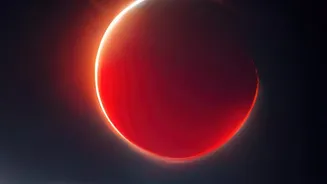
The month concludes with the famous Full Harvest Moon on September 26. This is the name given to the full moon that falls closest to the autumnal equinox. Traditionally, the bright light of this full moon for several nights in a row helped farmers to harvest their crops late into the evening. For the best view, watch the moon rise in the east just after sunset. Near the horizon, an optical effect known as the moon illusion can make it appear dramatically large and vibrantly orange. On the same night, the planet Neptune will be at opposition, its closest point to Earth for the year. While you'll need a telescope to see Neptune as a tiny blue-green dot, you can enjoy the splendor of the Harvest Moon with your naked eyes.