


A Cosmic Mystery in Red
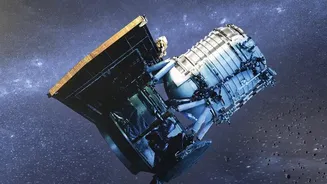
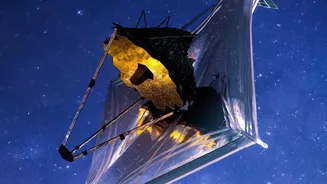
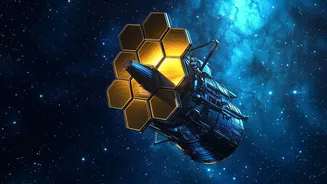
In the deepest images of our universe, against the black expanse of space, the James Webb Space Telescope (JWST) has consistently found them: faint, compact, and very red objects. Dubbed “little red dots” (LRDs), these mysterious sources appeared to exist
in the universe's infancy, around 600 million years after the Big Bang, but seemed to vanish as the cosmos matured. Their discovery in 2022 immediately sparked a debate among astronomers. Were they an unusually dusty type of young galaxy? Or were they something else entirely, something that could potentially rewrite our understanding of the early cosmos? The sheer number of them, and their extreme distance, made them a compelling puzzle.
Peeling Back the Layers
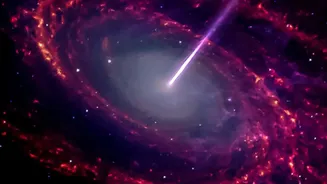
The initial hypothesis was that LRDs were active galactic nuclei (AGN)—the incredibly bright, energetic cores of galaxies powered by a feeding supermassive black hole. However, they didn't quite fit the profile. LRDs showed little of the X-ray emissions and high variability typically seen in AGNs. This led to other theories, including the mind-bending idea that they could be primordial, million-solar-mass stars. But the leading theory remained centered on black holes. The challenge was gathering enough evidence from objects so distant that their light has traveled for over 13 billion years to reach us.
Unmasking the Black Hole Engines
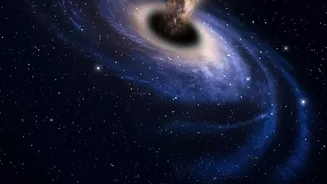
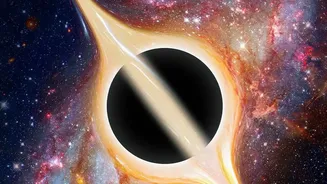
Recent studies have provided the strongest evidence yet that these dots are indeed powered by monstrous black holes. One study focused on an LRD named GLIMPSE-17775, using the Webb telescope to capture the deepest spectrum of light from such an object to date. The analysis revealed the unmistakable signatures of a ravenously feeding supermassive black hole, cocooned in a dense shroud of gas and dust. This structure, sometimes called a "black hole star," explains the object's reddish color and why its other characteristics differ from more familiar, unobscured quasars. The gas cloud absorbs most of the light, letting only the redder wavelengths pass through, while also explaining the lack of typical X-ray signals.
Rewriting the Rules of Growth
The confirmation that LRDs are supermassive black holes has profound implications. For decades, the prevailing theory was that galaxies form first, and the supermassive black holes at their centers grow along with them over billions of years. But some of these LRDs contain black holes that are astonishingly massive relative to their host galaxies—in some cases, appearing almost 'naked' without a significant galaxy around them. One was found to have a black hole that accounts for over two-thirds of its total mass. This completely flips the script, suggesting that some of the universe's first and largest black holes may have formed before their galaxies, serving as the cosmic seeds around which the galaxies later grew.
What Happens to the Red Dots?
The mystery of why LRDs seem to disappear as the universe ages is also becoming clearer. A study published in July 2026 suggests that being an LRD is not a permanent state, but a temporary phase. As the supermassive black hole continues to feast on gas and dust, its intense radiation eventually blows away the obscuring cocoon. Once this shroud is cleared, the object would no longer look like a little red dot, instead evolving into a more traditional, bright quasar. Another theory posits that as we look at more recent cosmic epochs, the host galaxies around these black holes have grown large enough to be seen, meaning the 'dot' is just the bright core of a much larger structure that was previously invisible to us.