




A Galaxy's Sudden Transformation
Until late 2019, the galaxy known as SDSS1335+0728 was just another unremarkable entry in cosmic catalogues. Located in the constellation Virgo, it was calm and inactive. Then, automated sky surveys, like the Zwicky Transient Facility in California, noticed
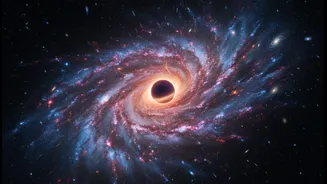
something extraordinary: the galaxy's core began to shine brighter than ever before. This wasn't a fleeting explosion like a supernova, which fades in months. Instead, the galaxy has continued to brighten for years, a change so profound that astronomers now believe they are witnessing the awakening of the supermassive black hole at its heart in real time — a first for science.
What It Means for a Black Hole to 'Wake Up'
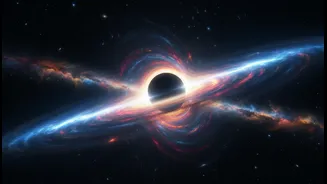
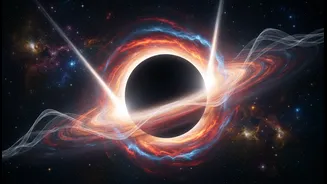
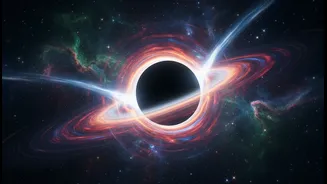
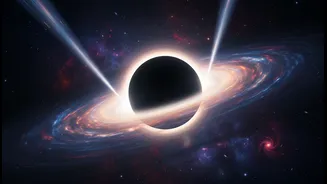
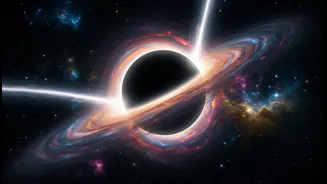
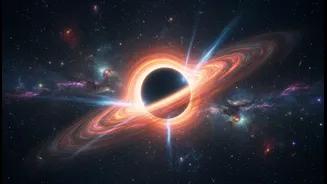
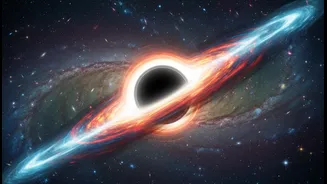
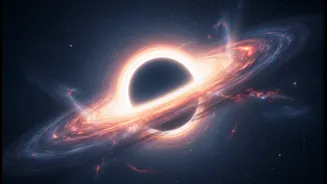
Most large galaxies, including our own Milky Way, host a supermassive black hole at their centre. These cosmic monsters are usually 'sleeping' and invisible unless they are actively feeding. An awakening occurs when a black hole starts pulling in and 'feasting' on a huge supply of surrounding gas and dust. As this material swirls into the black hole, it forms a brilliantly hot and bright structure called an accretion disk, which radiates immense energy across the light spectrum, from X-rays to radio waves. In the case of SDSS1335+0728, astronomers saw it light up in ultraviolet, optical, and infrared wavelengths, and it even began emitting X-rays in early 2024.
An Unprecedented Scientific Opportunity
Catching a black hole in the act of turning on is a game-changer. Previously, scientists could only study galaxies that were already active or completely dormant. The transition phase was purely theoretical. This event is like finding a 'Rosetta Stone' for black hole physics, providing a unique before-and-after picture of one of the universe's most fundamental processes. A global network of observatories, including the European Southern Observatory's Very Large Telescope (VLT) in Chile, is now intensely monitoring the galaxy. These powerful tools allow researchers to gather data on how the activation impacts the entire galaxy.
The Questions This Discovery Could Answer
This real-time observation is expected to fuel discoveries for years to come. Astronomers hope to finally answer key questions about how black holes grow and influence their host galaxies. There is a known correlation between the mass of a galaxy's central black hole and the galaxy itself, suggesting they evolve together, but the 'how' remains a mystery. By watching this process unfold, scientists can test their models of black hole feeding mechanisms and learn what triggers a black hole to switch on. The data will help clarify the role these giants play in regulating star formation and shaping the largest structures in the cosmos.
What Happens Next?
The work is far from over. A worldwide collaboration of astronomers will continue to point their most advanced instruments at SDSS1335+0728. While the leading theory is an awakening black hole, researchers are still working to definitively rule out other, more exotic possibilities, like a very unusual, slow-motion tidal disruption event where a star is torn apart. Regardless of the final conclusion, the event provides invaluable information on the evolution of galactic cores. The sustained monitoring will offer a rare, live view into the heart of a transforming galaxy, promising a new chapter in our understanding of these enigmatic cosmic titans.