



An Invisible Rain from Space
Cosmic rays are not actually 'rays' in the sense of light; they are atomic nuclei—mostly protons—that have been accelerated to nearly the speed of light by some of the universe's most violent events. They constantly bombard Earth from all directions,
but the most energetic and interesting ones are incredibly rare. Scientists are eager to study them because they offer clues about their cataclysmic origins, such as exploding stars or the environments around supermassive black holes. However, directly capturing these particles before they hit our atmosphere is almost impossible due to their scarcity and extreme energies.
Using the Atmosphere as a Detector
Instead of trying to catch the cosmic ray itself, scientists use a clever workaround: they let the particle do the work for them. When a primary cosmic ray smashes into an air molecule high in the atmosphere, it triggers a massive cascade of secondary particles, including electrons, photons, and muons. This cascade, known as an 'extensive air shower', can spread out over many square kilometres by the time it reaches the ground. In essence, the entire atmosphere becomes a giant particle detector, and the air shower is the evidence that a cosmic ray has arrived.
Seeing the Unseeable Flashes
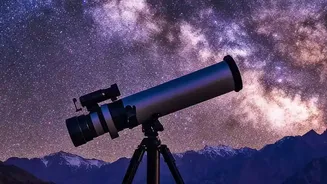
This is where the high-precision telescopes come in, but they aren't looking for the particles directly. They are built to detect the two types of faint, fleeting light produced by the air shower. The first method detects the faint ultraviolet 'fluorescence' light emitted when shower particles excite nitrogen molecules in the air. The second, more common method detects what is known as Cherenkov radiation. This is a faint, blueish flash of light produced when the shower's particles travel faster than the speed of light in air. These flashes are incredibly brief and dim, requiring highly sensitive, large mirrors and fast cameras to capture.
Why Precision Is Everything
Capturing these faint flashes is only the first step. High-precision measurements are crucial for reconstructing the story of the original cosmic ray. By using multiple telescopes in an array, scientists can view the same air shower from different angles, similar to how our two eyes provide depth perception. The precise timing of when the light hits different detectors allows researchers to determine the cosmic ray's original direction of arrival with incredible accuracy. Furthermore, the shape, intensity, and footprint of the light pool on the ground are used to calculate the primary particle's immense energy and even make an educated guess about what kind of particle it was.
Observatories on the Front Line
World-class facilities like the Pierre Auger Observatory in Argentina and the High-Altitude Water Cherenkov (HAWC) Observatory in Mexico are pioneers in this field. Auger uses a hybrid system of 1,600 surface detectors (tanks of pure water that detect Cherenkov radiation) spread over 3,000 square kilometres, overseen by fluorescence telescopes. HAWC, located at an altitude of 4,100 meters, uses 300 large water tanks to achieve high sensitivity. The next-generation Cherenkov Telescope Array (CTA), with sites in both hemispheres, promises to be up to 10 times more sensitive than current instruments, pushing our view of the high-energy universe even further.