




A Monsoon in Flux
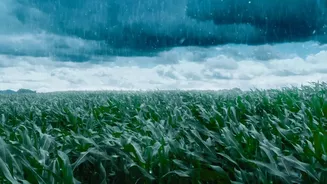
For centuries, life in India has moved to the rhythm of the monsoon. But that rhythm is becoming unpredictable. Climate change is altering historical weather patterns, leading to significant shifts in how and when rain falls across the subcontinent. Instead
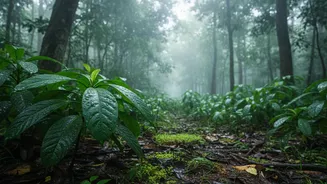
of steady, season-long showers, we are increasingly seeing long dry spells punctuated by short, intense bursts of extreme rainfall. This 'new normal' has profound implications, not just for our cities and farms, but for the vast forested landscapes that are crucial to our environmental stability. Scientists across the country are racing to understand how these evolving rainfall patterns are reshaping India's diverse forests, from the Himalayas to the Western Ghats.
A Complex, Mixed Picture
The impact of changing rainfall is not uniform; it's a tale of regional contrasts. Some studies show a surprising 'greening' trend in over 80% of central India's forests, suggesting that in certain areas, increased CO2 and rainfall intensity may be boosting vegetation growth. Another study projects that carbon storage in forests could increase, particularly in semi-arid and desert zones. However, this is not a simple good news story. This same greening can be deceptive. In key regions like the Western Ghats and the Northeast, even as leaf cover increases, the forests' ability to absorb carbon dioxide has been found to be decreasing. This is because higher temperatures and water stress can hinder the fundamental process of photosynthesis, even if there appears to be more foliage.
Forests Under Stress
The real story emerging from the research is one of increasing stress. In central India's Panchmarhi Biosphere Reserve, for instance, a combination of rising temperatures and shifting rains has contributed to a 13% loss of forest cover over nearly 50 years, increased fire risk, and a decline in forest health. Dry deciduous forests, which operate closer to moisture stress thresholds, are proving particularly vulnerable. In the Western Ghats, erratic monsoons and intense downpours on dry soil are increasing the frequency of landslides, even in lush, forested areas. These extreme weather events destabilise slopes and can lead to the collapse of entire forest patches. The delicate life cycles of trees and plants are also being disrupted, affecting everything from leaf development to pollination.
The Ripple Effect on Ecosystems
What happens in the forest doesn't stay in the forest. The shifts being observed have significant ripple effects. Weakening monsoons in the past have been linked to the expansion of savannas at the expense of deciduous forests in peninsular India. Today, these changes impact biodiversity, with some species struggling to adapt or migrating to find more suitable habitats. This also has a direct human cost. Forests are the source of many of our major rivers, and their health is intrinsically linked to water security for millions. Changes in forest cover and health can alter rainfall distribution, affecting agricultural output in a country still heavily reliant on its harvests. The destruction of central Indian forests, for example, could further disrupt rainfall patterns nationwide.
Building Resilience for the Future
The scientific consensus is clear: while some of India's forests show remarkable resilience, they are facing unprecedented pressure. The response, according to researchers, lies in evidence-based conservation and management. Studies highlight that biodiversity is a key driver of resilience; a more diverse forest is more likely to contain species that can withstand environmental shocks. Therefore, protecting and enhancing biodiversity within contiguous forest patches is crucial. It also involves smarter land use planning, re-evaluating development activities on vulnerable slopes, and potentially using climate-resilient afforestation techniques. Ultimately, proactive management based on scientific assessments will be key to helping our forests adapt to a future of climatic uncertainty.