





The Impossible Star
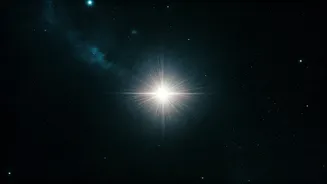
Meet HD 140283, a star located about 190 light-years from Earth in the constellation Libra. To the casual observer, it's just another point of light. But to astronomers, it's a profound cosmic puzzle. Informally nicknamed the 'Methuselah star' after the long-lived
biblical figure, it has been known to science for over a century due to its incredible speed across the sky. The real mystery began when scientists first tried to calculate its age. Initial estimates were shocking, suggesting the star could be as old as 16 billion years. This presented a significant problem: the universe itself is estimated to be about 13.8 billion years old. An object cannot be older than the container it exists in, creating a paradox that sent astronomers scrambling for an explanation.
How Do You Age a Star?
Determining a star's age isn't as simple as counting rings on a tree. Astronomers use a variety of sophisticated methods. One key technique involves plotting a star's brightness against its temperature on what's called a Hertzsprung-Russell diagram. A star's position on this chart reveals where it is in its life cycle, from a young, stable star to an aging giant. Scientists also analyze a star's composition. Stars formed early in the universe are made almost purely of hydrogen and helium, the elements created in the Big Bang. Later generations of stars, like our sun, are richer in heavier elements, or 'metals', which are forged inside earlier stars and scattered by supernova explosions. The Methuselah star is extremely metal-poor, a clear sign of its ancient origins.
Unraveling the Mystery
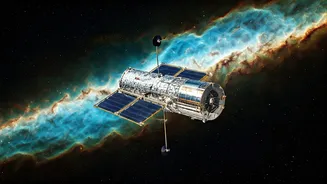
Confronted with the age paradox, scientists knew something in their calculations had to be off. It could have been an error in understanding stellar physics, the age of the universe, or the measurements of the star itself. A team led by astronomer Howard Bond used NASA's Hubble Space Telescope to get a more precise measurement of the star's distance. By measuring its parallax—the tiny apparent shift in its position as Earth orbits the sun—they could more accurately determine its true luminosity, or brightness. Knowing the precise distance is crucial; if you get it wrong, all other calculations, including age, will be skewed. They also re-examined the star's chemical makeup, finding it had a higher-than-expected oxygen content, which also influences age estimates.
A New, More Reasonable Age
With this new, more precise data, the team recalculated Methuselah's age. The new figure was around 14.5 billion years, with a margin of error of about 800 million years. While this number is still technically older than the universe, the large uncertainty means its true age could comfortably fall within the 13.8-billion-year cosmic limit. Subsequent studies have continued to refine the age, with some estimates placing it closer to 12 or 13.7 billion years, neatly resolving the paradox. While no longer impossibly old, HD 140283 remains one of the oldest stars ever discovered with a well-determined age. It must have formed very shortly after the Big Bang.
A Visitor from a Lost Galaxy
The Methuselah star isn't just old; it's a traveler with a dramatic past. Its high speed and elongated orbit are evidence that it is just a visitor to our stellar neighborhood. Astronomers believe the star was likely born in a primeval dwarf galaxy that was later torn apart and absorbed by our own growing Milky Way more than 12 billion years ago. Its peculiar orbit is the lasting scar from that ancient act of galactic cannibalism. This makes HD 140283 a 'living fossil', a direct link to a lost and mysterious epoch in the history of the universe. Studying it gives us a rare glimpse into the building blocks of our own galaxy and the conditions of the very early cosmos.