




In the vast darkness of space, 'failed stars' drift alone. Now, NASA's SPHEREx survey is giving us our best look yet at these cosmic misfits, revealing atmospheres rich with water and methane, the very building blocks of life.
Meet the Failed Stars
So, what exactly is a 'failed
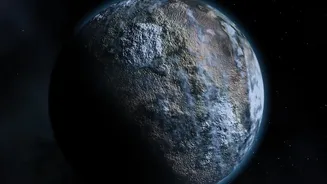
star'? Scientists call them brown dwarfs. These celestial objects are one of the universe's fascinating in-betweeners. They form just like stars do, from the gravitational collapse of massive clouds of gas and dust. However, they never quite accumulate enough mass to kick-start the nuclear fusion of hydrogen in their cores — the process that makes stars like our sun shine brightly. While they are not stars, they aren't quite planets either. The most massive brown dwarfs can be up to 80 times the mass of Jupiter. They are dimly glowing balls of warm gas, heated by the leftover energy from their formation rather than a stellar engine. Because they are not tethered to a host star, they drift through the cosmos as solitary wanderers, making them difficult to find but also fascinating to study. As one scientist described them, they are 'kind of goth', fading into eternity alone.
A New Eye on the Sky
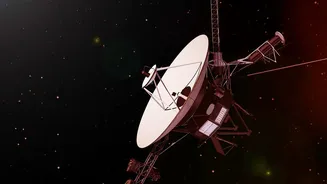
The key to this discovery is NASA's SPHEREx telescope, which stands for Spectro-Photometer for the History of the Universe, Epoch of Reionization, and Ices Explorer. Launched in March 2025, this powerful infrared observatory is on a two-year mission to map the entire sky. While its main goals include studying the origins of the universe and galaxies, it has proven to be an exceptional tool for hunting brown dwarfs. Unlike ground-based telescopes, which are hindered by water vapor in Earth's atmosphere, SPHEREx operates from space, giving it a clear view of infrared light. This is crucial because brown dwarfs are too cool to shine brightly in visible light; their faint heat glows in the infrared spectrum. SPHEREx is systematically scanning the heavens, and in the process, it is finding thousands of these elusive objects that were previously hidden in the dark.
Decoding a Chemical Barcode
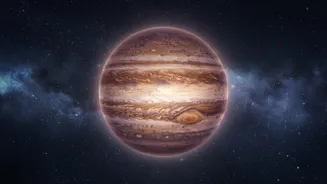
SPHEREx doesn't just find brown dwarfs; it analyzes what they are made of. The telescope measures the brightness of an object across 102 different colours of infrared light. This data creates a unique spectrum for each object. Different molecules in an atmosphere absorb light at specific wavelengths, leaving behind distinctive gaps in the spectrum — think of it as a chemical barcode. By reading these barcodes, scientists can identify the molecules present. In a recent study of 37 nearby brown dwarfs, the SPHEREx team found the unmistakable signatures of water, methane, carbon monoxide, and carbon dioxide. This confirms that these lonely worlds have chemically rich atmospheres, in some ways not dissimilar to the gas giants in our own solar system, like Jupiter.
Why This Finding Matters
Detecting these molecules is significant for several reasons. First, it vastly expands our catalogue of known brown dwarfs, moving from studying a few dozen to analyzing thousands. This wealth of data allows for a much broader understanding of their diversity. The findings are already challenging existing scientific models, particularly for brown dwarfs in a key transitional phase of their life as they cool down. It turns out that even two brown dwarfs at the same temperature can have strikingly different spectra, suggesting their atmospheric processes are more complex than previously thought. Furthermore, because brown dwarfs are not overwhelmed by the glare of a parent star, they serve as pristine laboratories for understanding planetary-like atmospheres. Studying their chemistry helps scientists understand how these fundamental ingredients for life are distributed throughout the galaxy and how they behave under different conditions, providing clues about the formation of planets everywhere.