

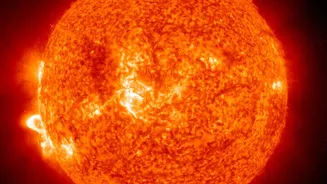
To truly understand our Sun's volatile nature, one pair of eyes is no longer enough. A groundbreaking collaboration between India's Aditya-L1 and Europe's Proba-3 missions is proving that two spacecraft working in tandem can unlock solar secrets.
A Star of Enduring Mystery
The Sun,
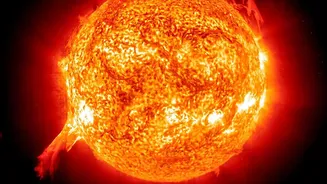
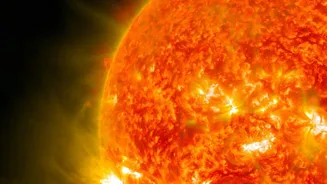
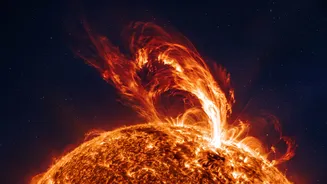
our life-giving star, harbours profound mysteries. One of the most perplexing is its atmosphere, the corona, which sizzles at millions of degrees Celsius, far hotter than the surface below. This superheated region is the source of violent solar eruptions, known as coronal mass ejections (CMEs), which hurl vast clouds of plasma and magnetic fields into space. When aimed at Earth, these events can disrupt our satellites, endanger astronauts, and cripple power grids. For decades, scientists have struggled to observe the very birth of these eruptions close to the Sun's bright surface, a region critical for understanding and forecasting this hazardous space weather.
India's Unblinking Eye: Aditya-L1
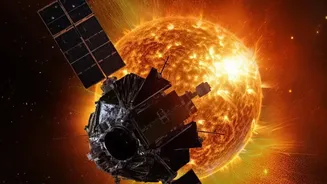
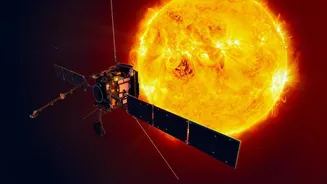
Launched by ISRO in September 2023, Aditya-L1 is India's first dedicated solar observatory. It is strategically positioned at the first Lagrange point (L1), a gravitationally stable spot 1.5 million kilometres from Earth, which allows for a continuous, uninterrupted view of the Sun. Aditya-L1 is equipped with seven distinct instruments designed to observe the Sun's various layers, from its surface to the outer corona. Its primary coronagraph, the Visible Emission Line Coronagraph (VELC), is uniquely capable of studying the solar corona closer to the Sun's disk than many previous instruments, providing crucial data on the temperature, velocity, and density of solar plasma during the initial moments of an eruption.
Europe's Artificial Eclipse: Proba-3
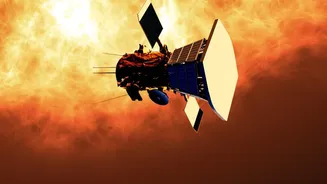
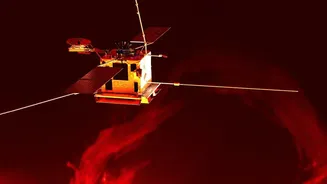
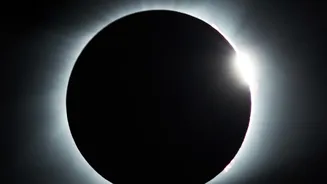
The European Space Agency's (ESA) Proba-3 mission, launched aboard an Indian PSLV rocket in December 2024, is a feat of engineering. It consists of two satellites flying in precise formation, approximately 150 metres apart. One satellite, the 'Occulter', flies in front and casts a precise shadow over the other, the 'Coronagraph'. This creates a sustained artificial solar eclipse in space, blocking the Sun's blinding glare and allowing the coronagraph instrument, ASPIICS, to capture incredibly detailed images of the faint inner corona. While a natural eclipse lasts only minutes, Proba-3 can maintain this perfect alignment for up to six hours at a time, offering an unprecedented window into the Sun's atmosphere.
A Synergy of Science
The true power of this partnership lies in how the two missions complement each other. While they are separate projects, scientists have begun to jointly analyse their observations of the same solar events. In a recent study of two CMEs, researchers combined data from Aditya_L1's VELC and Proba_3's ASPIICS. Aditya_L1 provided spectroscopic data, revealing the temperature and density of the erupting material. Simultaneously, Proba_3 delivered high_resolution images showing the eruption's shape, mass, and movement. By combining these two different types of data, scientists can cross_check their measurements and build a much more complete, three_dimensional picture of how a CME evolves in its earliest, most crucial stages. This dual perspective provides a more robust understanding than either spacecraft could achieve alone.
A Blueprint for Global Collaboration
This joint scientific effort is a highlight of the long_standing and strengthening partnership between ISRO and ESA. The agencies formally extended their cooperative agreement in September 2026, expanding it to include areas like space weather and joint exploration. In January 2026, scientists from both agencies met for a joint workshop to foster long_term collaboration using data from Aditya_L1 , Proba_3 , and ESA 's Solar Orbiter . The fact that ISRO launched ESA 's Proba_3 mission further cements this relationship . This successful scientific teamwork not only advances our understanding of the Sun but also serves as a model for future international space endeavours , showing how sharing data and capabilities can lead to greater discoveries for the benefit of all .