



What Exactly Is Shadow Boxing?
At its core, shadow boxing is a solo training drill where you move, punch, and practice defensive techniques against an imaginary opponent. It’s used by everyone from world champion boxers to fitness beginners because it allows you to focus purely on technique,
balance, and movement without the distraction of hitting a heavy bag. Think of it as a full-body dance where you are simultaneously the choreographer and the performer, engaging your muscles and your mind. The goal isn't to throw wild, powerless punches but to execute crisp, controlled movements that build muscle memory, cardiovascular endurance, and coordination.
The Full-Body Fitness Benefits
The beauty of shadow boxing lies in its efficiency. It’s a high-intensity workout that engages your entire body. Every punch starts from the ground, travelling through your legs and hips, rotating through your core, and finally extending through your shoulder and arm. This chain reaction builds functional core strength and stability. Furthermore, the constant movement makes it a fantastic cardiovascular exercise, improving endurance and burning a significant number of calories. Because there is no impact from hitting a target, it’s also a low-impact activity that's easier on your joints than running. The mental benefits are just as significant; visualizing an opponent and reacting to their imagined moves sharpens focus and can be a great form of stress relief.
Finding Your Foundation: The Stance
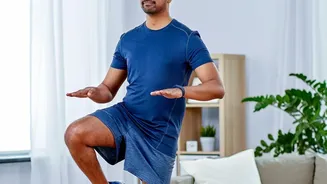
Before throwing a single punch, getting your stance right is critical. Stand with your feet about shoulder-width apart. If you're right-handed, your left foot will be forward (this is an 'orthodox' stance). Your lead foot should point mostly forward, while your rear foot is angled slightly outward for stability. Keep a slight bend in your knees and your weight evenly distributed, staying light on the balls of your feet. Your hands form your 'guard'. Bring them up to your cheeks with your elbows tucked in to protect your ribs. Tuck your chin down slightly. This balanced, ready position is your home base for all offensive and defensive moves.
Mastering the Basic Punches
For a fitness-focused workout, you only need to know a few key punches. Focus on form over power, ensuring you extend your punches without locking your elbow and always return your hand to your guard. The four essential punches are:
1. The Jab: A quick, straight punch with your lead hand. It's used to measure distance.
2. The Cross: A straight, powerful punch with your rear hand. As you punch, rotate your hips and pivot on your back foot to generate force.
3. The Hook: A semi-circular punch thrown with either hand, targeting the side of your imaginary opponent. Power comes from hip rotation.
4. The Uppercut: A short, rising punch thrown with either hand, great for close range.
The Secret Ingredient: Light Steps
Shadow boxing without footwork is just punching the air. Constant movement is what makes it a dynamic workout. The headline's 'light steps' refer to boxer's footwork: staying on the balls of your feet and making small, deliberate movements. Practice moving forward, backward, and side-to-side without crossing your feet. To move forward, push off your back foot and step with your lead foot first. To move back, do the opposite. Another key movement is the pivot. By rotating on the ball of your lead foot, you can create new angles of attack and defense, turning your whole body with agility. This footwork keeps your heart rate up and your legs engaged, making the workout truly full-body.
Putting It All Together: A Beginner’s Routine
A great way to start is with timed rounds, just like in a real boxing match. A simple structure can provide a fantastic workout. Use a timer for 3rdrdrdrdrdrdrdrdrdrdrdrdrdrdrdrdrdrdrdrdrdrdrdrdrdrdrdrdrdrdrd3nd minute rounds with a 1nd minute rest in between.
Round 1:
Footwork & Jabs.
Move around your space using basic footwork.
Throw only jabs,
focusing on keeping your guard up and staying balanced.
Round 2:
Adding the Cross.
Continue moving,
now throwing jabnd cross combinations (a '1nd').
Focus on rotating your hips with the cross and snapping your punches back to your guard.
* Round 3:
Freestyle.
Mix in all four punches (jabs,
crosses,
hooks,
uppercuts)
while continuing to move.
Try throwing three or fournd punch combinations,
then moving out of range.
Don't forget to incorporate defensive slips and rolls.
Practicing in front of a mirror can be a great way to check your form.