




Meet the Ghost Particle
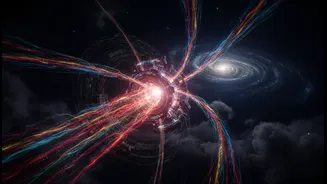
First, let's talk about neutrinos. They are fundamental particles with almost no mass and no electric charge. This makes them incredibly difficult to detect; trillions pass through you every second, but almost none interact with your body. They are created
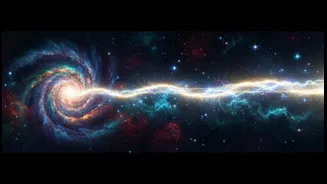
in extreme cosmic events, like exploding stars or near supermassive black holes. Because they travel in straight lines, unaffected by magnetic fields, they are perfect messengers from the far reaches of the universe. The catch is that their reluctance to interact with anything also makes them nearly impossible to trace. Scientists have built massive detectors, like the IceCube observatory buried in a cubic kilometre of Antarctic ice, just to catch the rare flash of light one makes when it finally collides with an atom.
Einstein’s Cosmic Magnifying Glass
Now, let’s bring in gravitational lensing. According to Albert Einstein's theory of general relativity, massive objects like galaxies and galaxy clusters warp the fabric of spacetime around them. As light from a more distant object travels past this massive body, its path is bent. This “lens” doesn't just bend the light; it can magnify it and create multiple, distorted images, sometimes smearing the distant object into an arc or even a perfect circle known as an Einstein Ring. You can see a simple version of this by looking at an object through the curved base of a wine glass. Astronomers use this effect to see galaxies that would otherwise be too far away and faint to observe.
Connecting Ghosts to a Lens
So, how do you use a lens for light to find a source of neutrinos? While neutrinos are affected by gravity, the lensing effect on a single particle is not currently detectable. Instead, astronomers use a clever, multi-messenger approach. When a high-energy neutrino is detected by an observatory like IceCube, an alert is sent out. Telescopes around the world then quickly scan the patch of sky the neutrino came from. They are not looking for the neutrino itself, but for a cataclysmic event—like a star-forming galaxy or an active black hole—that could have produced it. If that source happens to be gravitationally lensed, it's a huge clue. The multiple, warped images of the source seen by telescopes all point back to a single point of origin, confirming the location with much greater accuracy.
The Case of the 'Shadow Blaster'
This exact technique recently led to a major breakthrough. On September 22, 2021, IceCube detected a very high-energy neutrino. Astronomers pointed their telescopes towards its origin and found a very distant, dusty star-forming galaxy. This galaxy, nicknamed the “Shadow Blaster,” was special because its light was being gravitationally lensed by another galaxy sitting in front of it. The lensing created visible golden arcs of light. This allowed scientists to confirm that this galaxy, which is 11 billion light-years away, was the likely source of the neutrino. It provided the first strong evidence that intensely star-forming galaxies, and not just black holes, are major neutrino factories in the early universe. The name 'Shadow Blaster' was chosen because the source itself is hidden behind thick clouds of dust, making it invisible in normal light but detectable in other wavelengths.