






The Challenge of Measuring a Changing Planet
Understanding climate change requires tracking incredibly subtle shifts in Earth's energy balance over many decades. Scientists rely on a fleet of Earth-observing satellites to gather this data, but this creates a fundamental problem of consistency. Just
like a photograph fades over time, satellite sensors degrade in the harsh environment of space, affecting the accuracy of their measurements. Furthermore, combining data from different satellites, launched by different agencies at different times, is like trying to create a perfectly seamless quilt from fabric scraps of slightly different shades. These tiny discrepancies and drifts introduce uncertainty, making it harder to definitively detect long-term trends and creating noise that can be exploited by sceptics to question the validity of climate science itself. To make confident decisions about our planet's future, we need data we can all trust implicitly.
A Gold Standard in Orbit
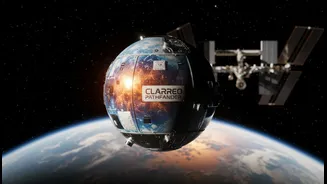
Enter NASA's CLARREO Pathfinder, a mission designed not just to collect more data, but to make all climate data better. Scheduled for launch and installation on the International Space Station (ISS), its primary goal is to serve as an on-orbit “metrology lab”—a reference point of unquestionable accuracy. The instrument at its heart is a highly advanced spectrometer that will measure the sunlight reflected from Earth with an accuracy five to ten times greater than existing sensors. Its measurements are designed to be SI-traceable, a term meaning they are directly anchored to the International System of Units—fundamental and unchanging standards of measurement. This effectively makes the Pathfinder a benchmark, providing a 'true north' for climate observations that doesn't change over time.
The Secret to Unprecedented Accuracy
How does CLARREO Pathfinder achieve such remarkable accuracy and, more importantly, maintain it? The secret lies in its ability to calibrate itself constantly. While other satellites are calibrated on the ground before launch and then slowly drift, the Pathfinder instrument can regularly point away from the Earth and directly at the Sun. The Sun serves as a stable, well-understood, and reliable source of light. By taking frequent measurements of this known quantity, the instrument can precisely identify and correct for any degradation or changes in its own sensors. This process of on-orbit self-correction ensures its high-fidelity measurements remain trustworthy throughout its entire mission, solving the core problem of sensor drift that has plagued long-term climate records. It can also use the Moon as another stable calibration target.
A Tuning Fork for Other Satellites
The mission's brilliance extends beyond its own measurements. Its second major objective is to act as a calibration standard for other satellites already in orbit. As the ISS circles the globe, the Pathfinder will at times be observing the same location on Earth at the same time as other crucial climate satellites, such as the CERES and VIIRS instruments. During these synchronized observations, Pathfinder provides a reference measurement of unparalleled accuracy. The other satellites can then compare their readings to Pathfinder’s 'gold standard' and adjust their own data to be more accurate. In essence, it acts like a tuning fork for the entire orchestra of Earth-observing instruments, ensuring that everyone is playing in the same key. This process of inter-calibration elevates the quality and consistency of the entire global climate monitoring system.
Detecting Climate Trends Decades Sooner
The ultimate payoff of this enhanced accuracy is clarity and speed. By stripping away the uncertainty from our climate data, scientists can detect the real, underlying trends of a warming planet much more quickly. According to NASA, the level of precision provided by CLARREO Pathfinder could allow researchers to identify climate change signals decades sooner than would otherwise be possible. This isn't just an academic achievement; it has profound implications. Greater certainty in our data leads to more robust climate models and gives policymakers a stronger, more defensible scientific foundation upon which to build environmental and economic strategies. It quiets the noise and allows the clear signal of our changing climate to be heard.