







In cricket, few roles are as thrilling as the pinch hitter—a batter promoted to unleash chaos and change a match's momentum in a flash. This tactic, born of innovation, redefined limited-overs cricket and created legends of the game.
Sanath Jayasuriya: The Pioneer
Before 1996, One-Day
International cricket followed a predictable script. But then came Sanath Jayasuriya. Initially considered a bowler who could bat, his promotion to the top of the order changed everything. During the 1996 World Cup, Jayasuriya and his partner Romesh Kaluwitharana launched blistering attacks inside the first 15 overs, a time when teams traditionally played cautiously. Jayasuriya’s method wasn't about textbook elegance; it was about brutal efficiency, using his powerful forearms to slash the ball over the infield. While others aimed for 50-60 runs in the opening powerplay, Sri Lanka regularly plundered over 100. His assaults against India and England in that tournament were defining moments that not only won matches but also earned him the Player of the Tournament award, cementing his legacy as the man who made pinch-hitting a World Cup-winning strategy.
Romesh Kaluwitharana: The Partner in Crime
Every great revolutionary needs a trusted ally, and for Jayasuriya, that was Romesh Kaluwitharana. A diminutive wicketkeeper-batsman, 'Little Kalu' was the other half of the duo that terrorised new-ball bowlers during Sri Lanka's golden run in 1996. While Jayasuriya was the main executioner, Kaluwitharana’s fearless aggression at the other end ensured there was no respite for the opposition. The strategy to promote him was a masterstroke just before the World Cup. While his individual scores during the tournament weren't always massive, his impact was measured in momentum. His quickfire cameos at blistering strike rates, like his 33 off 18 balls against Kenya, created the perfect platform for the middle order. His contribution, though sometimes overlooked in favour of Jayasuriya’s fireworks, was vital to the success of a tactic that changed ODI cricket forever.
Shahid Afridi: The Ultimate High-Risk Blaster
If pinch-hitting is about maximum impact in minimum time, then Shahid Afridi is its ultimate embodiment. In only his first international innings in 1996, the 16-yearold was sent in at number three against Sri Lanka as a pinch hitter and responded by smashing the thenfastest ODI century in history off just 37 balls. The innings, which included a recordequalling 11 sixes, instantly earned him the nickname 'Boom Boom' and set the tone for a career built on fearless aggression. Afridi was the quintessential 'boom or bust' player. His approach was simple: see ball, hit ball. This made him a captain's wildcard, capable of winning a match in a handful of overs or departing just as quickly. Unlike others on this list who evolved into permanent openers, Afridi was often used as a floating disruptor, a true pinch hitter sent in whenever an injection of chaos was needed.
Virender Sehwag: The Consistent Destroyer
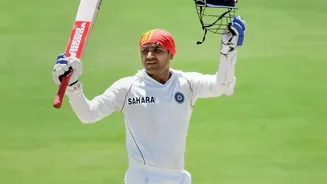
Virender Sehwag took the philosophy of pinch_hitting and turned it into a full_time art form. While others were tactical gambles, Sehwag made relentless aggression his standard mode of operation as an opener in both Test and ODI cricket. With minimal footwork and maximum intent, he dismantled bowling attacks with an audacity that was previously unseen, especially in the game's longest format. He is one of only two players in history to score a Test triple_century and an ODI double_century. His ODI strike rate of over 104 is a testament to his consistent dominance. Sehwag wasn’t just a slogger; he was a strategic attacker who proved that the pinch_hitter’s mindset could be sustained over a long and successful career, fundamentally altering the expectations for an opening batsman.
Adam Gilchrist: The Wicketkeeper Revolution
Adam Gilchrist redefined the role of the wicketkeeper_batsman, transforming it from a specialist position to that of a frontline attacker. Initially batting in the lower order, a gamble by captain Steve Waugh in 1998 saw him promoted to open the innings in ODIs, and he never looked back. Gilchrist combined technical correctness with devastating power, making him a consistent threat at the top of the order for Australia's all_conquering team of the late 90s and 2000s. He scored his maiden ODI hundred in just his second innings as an opener and went on to score 16 centuries in the format. His most memorable knock was a blistering 149 off 104 balls in the 2007 World Cup final. Gilchrist was more than a pinch hitter; he was an attacking opener of the highest class who embodied the aggressive spirit that the original pinch hitters had introduced to the game.