






The Science of a Fuzzy First Look
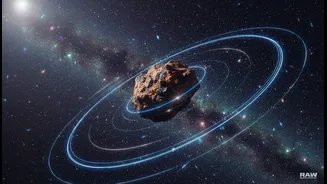
When astronomers first spot a new Near-Earth Object (NEO), the initial data is limited. They might only have a few observations showing the asteroid as a faint speck of light moving against background stars. From this short arc of movement, they can only make
a rough estimate of its orbit. Think of it like trying to predict the exact landing spot of a cricket ball after seeing just the first few feet of its journey off the bat. You know the general direction, but there's a huge cone of uncertainty about where it will ultimately land. This initial, wide range of possible paths is why an impact with Earth, while unlikely, often cannot be ruled out immediately.
How More Data Shrinks Uncertainty
The feeling of certainty grows as more data comes in. Telescopes around the world, including those in networks used by the European Space Agency (ESA), conduct follow-up observations. Each new data point—a new position for the asteroid at a specific time—allows scientists to refine their orbital calculations. As they plot more of the asteroid's path, the cone of uncertainty shrinks dramatically. In most cases, this refined trajectory shows that the asteroid will miss Earth by a comfortable margin. Paradoxically, the impact probability can sometimes increase slightly after the initial discovery before it drops to zero. This happens when the shrinking zone of uncertainty still contains Earth, making a collision appear statistically more concentrated until it's finally excluded altogether.
Your Window into Asteroid Tracking
You don't have to be a professional astronomer to follow this process. The European Space Agency's Near-Earth Object Coordination Centre (NEOCC) provides public access to its data and analysis. The centerpiece is the NEO Risk List, a catalogue of all known objects with a non-zero chance of impacting Earth within the next 100 years. This isn't a list of doomsday rocks; it's a dynamic watchlist for objects that merit careful monitoring. Most objects on this list have an extremely low probability of impact and are eventually removed as their orbits become better understood.
Navigating the Asteroid Risk List
Visiting the NEOCC website, you can explore the Risk List yourself. You'll see columns for object designation, estimated diameter, and potential impact dates. Two key metrics to understand are the Torino Scale and the Palermo Scale. The Torino Scale (0-10) is a simplified communication tool for the public, where 0 means no hazard and 1 means a routine discovery that's extremely unlikely to be a concern. The vast majority of NEOs are a 0. The Palermo Scale is more technical, a logarithmic scale used by specialists to compare the risk of a potential impact against the background risk of an object of the same size hitting Earth over time. A negative value means the risk is lower than the average background risk.
Using ESA's Visualisation Toolkit
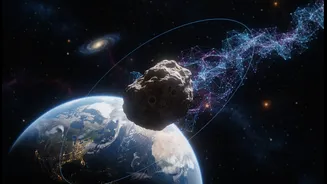
For a more interactive experience, the ESA NEO Toolkit offers several powerful web-based applications. The Orbit Visualisation Tool lets you see an asteroid's path in 3D, showing how it moves through the solar system relative to the planets. The Flyby Visualisation Tool creates a high-precision simulation of an object's close approach to Earth. You can even use the Observation Planning Tool and Sky Chart Display to find out when and where a specific asteroid might be visible in the night sky from your location. These tools demystify the process, turning abstract data into something you can see and explore, showing precisely why an object is, or more often isn't, a threat.