

Shadows That Tell a Story
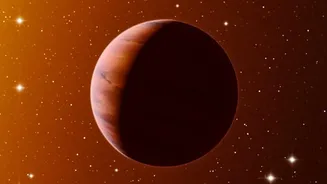
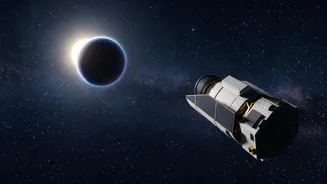
First, how do we even spot the atmosphere of a planet we can't really see? The most powerful technique is called transit spectroscopy. Scientists watch a star very closely, waiting for a planet to pass in front of it, an event called a 'transit'. As the planet crosses,
it blocks a tiny fraction of the starlight, causing a minuscule dip in the star's brightness. This is how many exoplanets are discovered in the first place. But the magic happens in that sliver of light that grazes the edge of the planet and passes through its atmosphere before continuing its journey to our telescopes. That light carries a secret message.
Reading a Planet’s Chemical Barcode
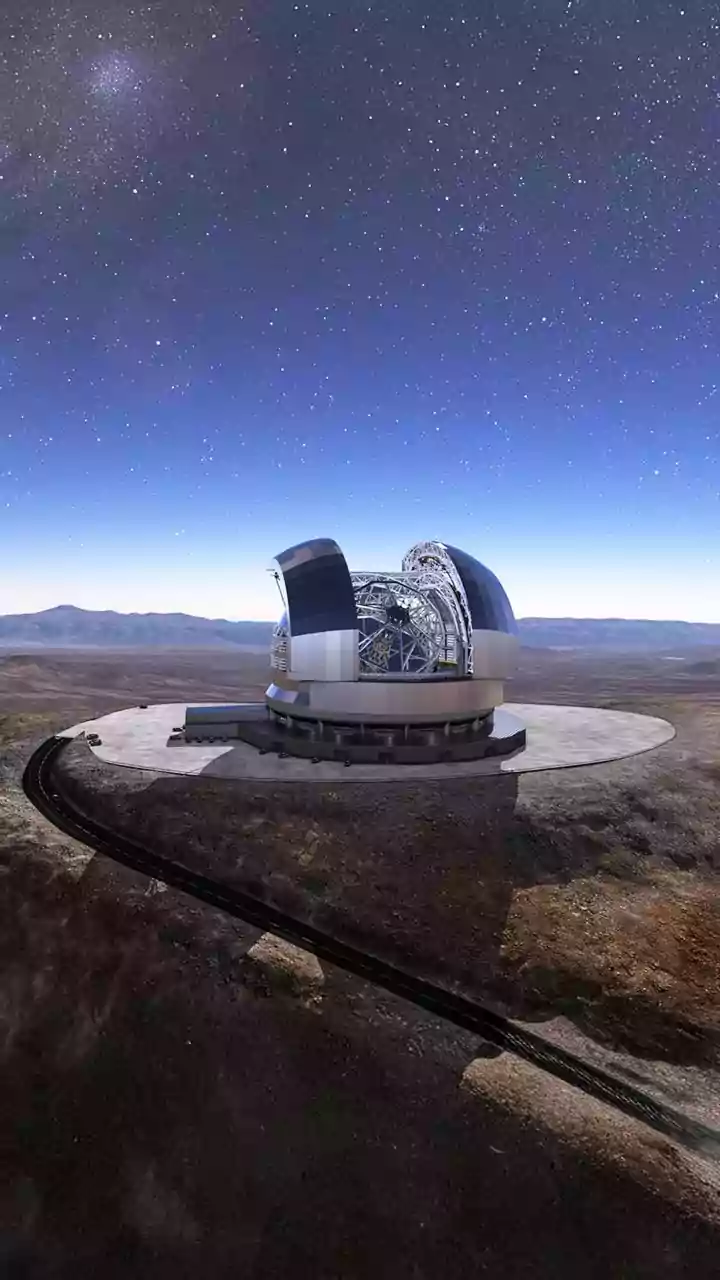
Think of the starlight as a pure, white light containing all the colours of the rainbow. When this light filters through an exoplanet’s atmosphere, the gases present in that atmosphere absorb very specific colours, or wavelengths, of light. Every gas has a unique absorption pattern, like a chemical barcode or fingerprint. Back on Earth, astronomers use powerful instruments called spectrographs to spread this incoming light into its full spectrum. By looking for the dark lines—the missing colours—in that barcode, they can figure out exactly what gases are in that planet’s atmosphere. It’s like cosmic detective work on a galactic scale.
The Search for Biosignatures
So, what are scientists looking for? They’re hunting for ‘biosignatures’—gases that are strongly associated with living processes. On Earth, life has completely transformed our atmosphere. The most sought-after ingredients include water vapour, a crucial component for life as we know it, and oxygen. Oxygen is highly reactive and would disappear from an atmosphere quickly unless it was being constantly replenished, which on Earth is done by plants and algae through photosynthesis. Another key gas is methane. Finding one of these might be interesting, but finding them together is the real prize. The combination of oxygen and methane in the same atmosphere would be a tantalising hint, as these two gases would normally destroy each other. Their co-existence suggests some continuous process, possibly life, is keeping them both topped up.
Ruling Out Cosmic Imposters
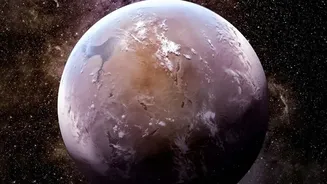
Of course, science is about being thorough. Astronomers have to be careful to rule out non-biological, or 'abiotic', sources for these gases. Volcanoes can release carbon dioxide, and sunlight splitting water molecules can create oxygen. The real challenge, and the focus of intense scientific debate, is determining what combination and quantity of gases would be an unmistakable sign of life. This is why context is everything. The type of star the planet orbits, its distance from that star, and its size all play a role in interpreting what the atmosphere is telling us. A planet's mass and size might make it look like a twin of Earth, but its atmosphere tells the real story of whether it's a paradise or a toxic wasteland like Venus.
New Eyes on the Universe
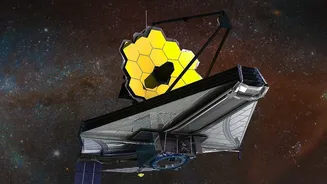
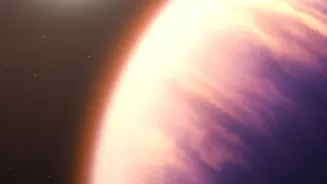
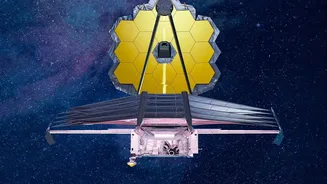
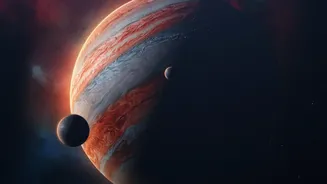
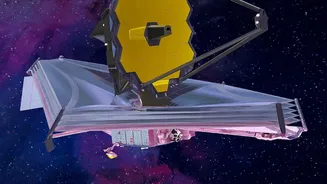
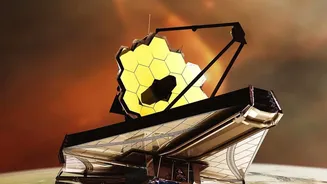
This entire field has been revolutionised by the James Webb Space Telescope (JWST). With its incredible sensitivity and ability to see in infrared light—where many of these chemical fingerprints are found—JWST is giving us a view of exoplanet atmospheres with stunning clarity. It has already detected water, carbon dioxide, and even signs of active chemistry and patchy clouds on distant gas giants. These early results are a spectacular proof of concept, demonstrating that our technology is finally powerful enough to sniff out the atmospheric composition of smaller, rocky, Earth-sized planets. Every observation sharpens our understanding and refines the search for that one special world.