





Why 15 Minutes Is a Game-Changer
Don't underestimate the power of a short workout. Research shows that brief, intense periods of exercise can be incredibly effective. This approach, often seen in circuit training or High-Intensity Interval Training (HIIT), boosts your metabolism, improves
cardiovascular health, and builds strength. The key is intensity. A focused 15-minute session where you push yourself is more beneficial than a longer, distracted workout. Plus, the biggest barriers to exercise are often time and energy. A short home workout removes both hurdles, making it easier to stay consistent, which is the real secret to fitness.
The Pre-Workout Warm-Up (2 Minutes)
Never skip your warm-up. It's essential for preventing injury by increasing blood flow to your muscles and preparing your body for movement. Spend about two minutes on these dynamic movements to get your body ready. Perform each for 30 seconds: - Jumping Jacks: A classic way to get your heart rate up. If jumping is uncomfortable, do a stepping version where you tap one foot out to the side at a time while raising your arms. - Arm Circles: Stand with feet shoulder-width apart and make large circles with your arms, first forward and then backward. - Leg Swings: Hold onto a wall for support and swing one leg forward and backward, then side to side. Switch legs.
Your 15-Minute At-Home Circuit
This circuit is designed to give you a full-body workout without any equipment. The structure is simple: perform each of the five exercises for 45 seconds, followed by a 15-second rest. This makes one round. Complete a total of three rounds. Set a timer and focus on maintaining good form.
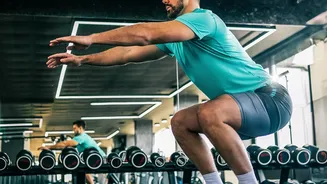
Exercise 1: Bodyweight Squats
Squats are a fundamental movement that strengthens your entire lower body and core. Stand with your feet shoulder-width apart, chest up. Lower your hips back and down as if you're sitting in a chair, keeping your back straight. Go as low as you comfortably can, aiming to get your thighs parallel to the floor. Push through your heels to return to the starting position.
Exercise 2: Push-Ups
This classic exercise builds upper body and core strength. Start in a high plank position with your hands slightly wider than your shoulders. Lower your body until your chest nearly touches the floor, keeping your body in a straight line. Push back up to the start. For a modification, perform the push-ups on your knees or against a wall.
Exercise 3: Alternating Lunges
Lunges target your quads, glutes, and hamstrings, while also improving your balance. Step one foot forward and lower your hips until both knees are bent at a 90-degree angle. Make sure your front knee is directly above your ankle. Push off your front foot to return to standing, and then repeat with the other leg.
Exercise 4: Plank
The plank is an isometric exercise that is fantastic for core stability. Place your forearms on the ground with your elbows directly under your shoulders and your hands clasped. Extend your legs back, lifting your hips so your body forms a straight line from head to heels. Engage your core and hold this position, being careful not to let your hips sag.
Exercise 5: Glute Bridges
This move is excellent for activating your glutes and hamstrings. Lie on your back with your knees bent, feet flat on the floor close to your hips, and arms by your sides. Pushing through your heels, lift your hips off the floor until your knees, hips, and shoulders form a straight line. Squeeze your glutes at the top before slowly lowering back down.
The Post-Workout Cool-Down (1 Minute)
Just as important as the warm-up, a cool-down helps your heart rate return to normal and can reduce muscle soreness. Spend a minute on some light static stretches, holding each for about 30 seconds. A simple hamstring stretch (sitting on the floor, extending one leg and reaching for your toes) and a quad stretch (standing, holding onto a wall, and pulling your heel toward your glute) are great options.