


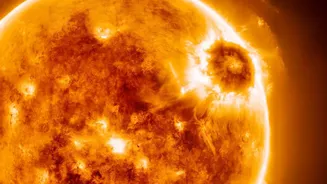
The Sun’s Inevitable Decline
Like all stars, our Sun has a finite lifespan defined by the fuel in its core. For the past 4.6 billion years, it has been in its stable main-sequence phase, fusing hydrogen into helium. But this process can't continue indefinitely. As the Sun exhausts
its core hydrogen over the next five billion years or so, its internal balance will break. The outward pressure from fusion will weaken, and the core will begin to contract and heat up, igniting a new phase of life that will be catastrophic for the inner solar system. This marks the beginning of the end for the Sun as we know it, setting the stage for a dramatic and violent transformation.
The Red Giant Transformation
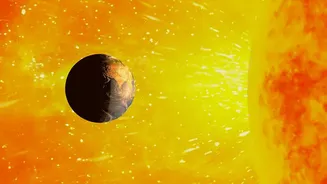
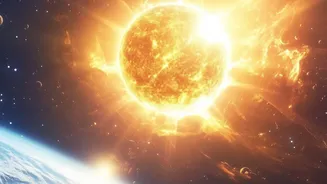
Once the core's hydrogen is spent, the Sun will start fusing helium, causing its outer layers to swell astronomically. It will expand into a red giant, potentially growing up to 256 times its current size. During this phase, it will become luminous enough to boil away the atmospheres of even the outer planets. Its expanding outer layers will almost certainly engulf and destroy Mercury and Venus. Earth’s fate hangs in the balance; while some models suggest it might be swallowed, others propose it could narrowly escape, though it would be left as a scorched, uninhabitable rock. This phase will last about a billion years before the Sun sheds its outer layers in a beautiful display called a planetary nebula, leaving behind its dense, hot core.
A New Star Is Born: The White Dwarf
What remains after the red giant phase is a stellar remnant known as a white dwarf. This Earth-sized object will contain about half of the Sun's original mass, packed into an incredibly dense sphere. No longer powered by nuclear fusion, a white dwarf is considered a 'dead' star, but it will still glow intensely hot for billions of years before eventually fading. As the Sun loses roughly half its mass during this transition, its gravitational pull on the remaining planets will weaken significantly. This is where the story gets truly interesting for the survivors.
The Great Survivors: Our Giant Planets
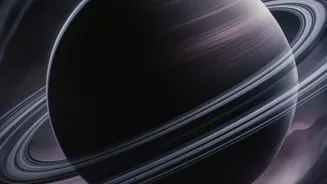
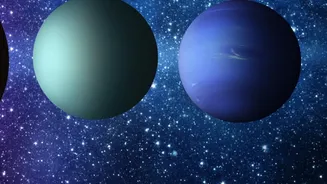
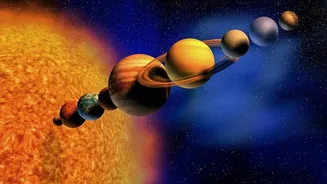
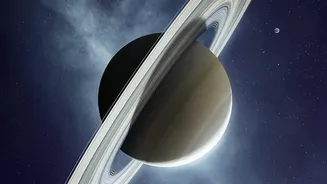
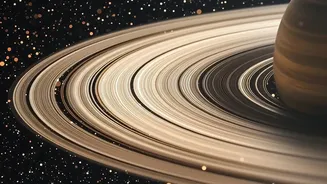
The gas giants—Jupiter, Saturn, Uranus, and Neptune—are located far enough away to escape being consumed by the expanding Sun. However, they won't emerge unscathed. The intense heat from the red giant phase will likely strip them of their rings and boil away the ices on their many moons, leaving behind only rocky cores. As the Sun sheds mass to become a white dwarf, its weaker gravity will cause the giant planets to drift outward into wider orbits, perhaps doubling their current distances. While they will survive the initial transformation, their new orbital arrangement might not be stable forever. Recent studies suggest that the random, violent ejections of mass from the dying Sun could create gravitational 'kicks' that destabilize the outer solar system much sooner than previously thought.
A Glimpse into Distant Futures
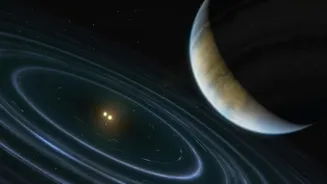
The study of our solar system's future isn't just a thought experiment; it provides a crucial framework for understanding the thousands of other planetary systems astronomers are discovering across the galaxy. Observations of existing white dwarfs with planetary remnants, like the Jupiter-sized planet WD 1856 b, confirm that giant planets can indeed survive their star's death. Some white dwarfs are even seen actively pulling in debris from shattered asteroids and moons, a process that might be orchestrated by the gravitational nudges of surviving giant planets. By studying how our own giant planets will fare, scientists can better interpret what they see around these distant, 'dead' stars, piecing together the chaotic final chapters of a planetary system's life.