








What is Dragonfly and Why Titan?
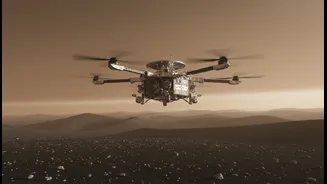
Dragonfly is a NASA rotorcraft-lander scheduled for a July 2028 launch, with an arrival at Titan planned for 2034. Unlike wheeled rovers limited to their landing zone, Dragonfly is a dual-quadcopter designed to fly between dozens of promising locations
on Titan's surface. Its primary goal is to study prebiotic chemistry—the complex chemical steps that occurred before life emerged. Led by the Johns Hopkins Applied Physics Laboratory, the mission will investigate whether Titan's environment is, or ever was, habitable. Titan was chosen because it is a unique celestial body. It's the only moon in our solar system with a dense atmosphere, primarily nitrogen like Earth's, and it has weather systems, complete with rivers, lakes, and seas of liquid methane and ethane. Scientists believe Titan's environment today may resemble the early Earth, offering a real-world laboratory to study the building blocks of life.
An Engineering Marvel for an Alien Sky
For engineers, Dragonfly represents a bold leap. Flying on another world is complex, but Titan offers some advantages. Its atmosphere is four times denser than Earth's, and its gravity is much lower, making it an ideal environment for a rotorcraft. The car-sized vehicle will use eight rotors to travel up to 175 kilometers during its multi-year mission, far surpassing the range of any previous surface mission. However, the challenges are monumental. The surface temperature on Titan hovers around a frigid -180 degrees Celsius (-292 F), requiring robust insulation and internal heating to protect the craft's sensitive electronics and batteries. Dragonfly is nuclear-powered, using the heat from its Multi-Mission Radioisotope Thermoelectric Generator (MMRTG) to keep its core warm enough to function. As of mid-2026, the spacecraft's structure has passed crucial vibration and structural tests, ensuring it can survive the launch and its long journey through space.
The Science Onboard
For students and space enthusiasts, the science instruments are where the real excitement lies. Dragonfly is a mobile laboratory. Its key instruments include drills on its landing skids to collect samples of surface materials. These samples will be fed into an onboard mass spectrometer, which will analyze their chemical composition in detail. The goal is to identify complex organic molecules and assess how far prebiotic chemistry has progressed. The mission will also carry a suite of meteorological and geophysical sensors to study Titan's atmosphere, measure 'Titanquakes' with a seismometer, and provide context for the surface samples. Cameras will capture stunning images of the landscape, not only for scientific analysis but also to help mission planners scout for the next safe and interesting landing spot. The initial landing site is planned for the Shangri-La dune fields near the equator, with an ultimate goal of exploring the Selk impact crater, a site where scientists believe liquid water may have once mixed with organic materials.
Managing Expectations: What to Conclude
It is crucial to understand what Dragonfly is—and isn't—designed to do. The mission's primary objective is to investigate chemical biosignatures and habitability, not to find current, living organisms. As Principal Investigator Zibi Turtle has stated, it's a mission to investigate the chemistry that came before biology. The project is one of the most ambitious planetary science missions ever attempted, and success is not guaranteed. The craft must survive a high-velocity entry into Titan's atmosphere, a two-hour descent, and then autonomously execute dozens of flights in an alien environment over several years. The data it sends back across more than a billion kilometers will be painstakingly analyzed for years. While the prospect of discovering the ingredients for life is thrilling, the true success of Dragonfly will be in the unprecedented data it collects about a world that could hold fundamental answers about our own origins.