






Why Your Chair Is the Culprit
Sitting for extended periods does more than just make you feel stiff; it actively changes your body's mechanics. When you're seated, your hip flexors shorten and tighten, which can pull your pelvis forward and strain your lower back. Meanwhile, your glute
muscles, which are crucial for pelvic stability, become inactive and weak—a condition sometimes called 'gluteal amnesia'. This combination forces your lower back and hamstrings to overcompensate. Furthermore, constant sitting, especially with poor posture, puts continuous pressure on your spinal discs, reduces blood flow, and can lead to stiffness and chronic pain. Over time, your mid-back (thoracic spine) loses its ability to rotate, forcing your neck and lower back to take on extra stress.
Your 10-Minute Daily Rescue Routine
You don't need a full gym session to counteract this daily toll. A short, targeted mobility routine can awaken dormant muscles, lubricate joints, and restore movement where you need it most. The key is consistency. Performing these four drills daily will take about 10 minutes and can significantly improve your spinal health and hip mobility. Set a reminder, step away from your desk, and give your body the movement it craves.
Drill 1: Cat-Cow for a Flexible Spine
This fundamental yoga pose is excellent for gently moving the entire spine and relieving tension from the neck to the lower back. It improves spinal mobility and activates core muscles that support your back. How to do it: Start on your hands and knees with your wrists under your shoulders and your knees under your hips. On an inhale (Cow pose), drop your belly towards the floor, lift your chest and tailbone, and look forward. On an exhale (Cat pose), press into your hands, round your upper back toward the ceiling, and tuck your chin to your chest. Flow smoothly between these two poses for 60-90 seconds, coordinating the movement with your breath.
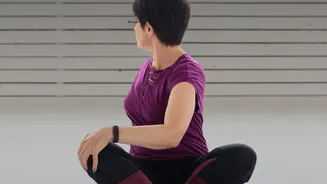
Drill 2: Seated Thoracic Rotations to Unlock Your Mid-Back
Desk work often involves staring straight ahead, leaving the mid-back stiff and immobile. This drill specifically targets that area, restoring healthy rotation to the thoracic spine. How to do it: Sit tall on the edge of your chair with your feet flat on the floor. Cross your arms over your chest, placing each hand on the opposite shoulder. Keeping your hips still and facing forward, slowly rotate your torso to the right as far as you comfortably can. Hold for a breath, then return to the center and rotate to the left. Perform 8-10 slow rotations to each side, focusing on the movement coming from your upper back, not your waist.
Drill 3: The World's Greatest Stretch for Hip Opening
This dynamic stretch lives up to its name by targeting multiple areas at once: it opens the hip flexors, stretches the hamstrings, and mobilizes the thoracic spine. How to do it: Start in a push-up position. Step your right foot forward to the outside of your right hand, sinking into a deep lunge. Keep your left leg straight behind you. Place your left hand firmly on the floor, then lift your right hand and rotate your torso to the right, reaching toward the ceiling. Follow your hand with your eyes. Bring your right hand back to the floor, then step back to the starting position. Repeat on the other side. Continue alternating sides for 2-3 minutes.
Drill 4: Glute Bridges to Reactivate Your Hips
After sitting all day, your glutes need a reminder to fire. The glute bridge is a simple but powerful exercise to wake them up, which helps stabilize your pelvis and reduce strain on your lower back. How to do it: Lie on your back with your knees bent, feet flat on the floor about hip-width apart, and your heels a few inches from your glutes. Rest your arms by your sides. Before you lift, gently squeeze your glutes. Drive through your heels to lift your hips until your body forms a straight line from your shoulders to your knees. Squeeze your glutes tightly at the top for a two-second count, being careful not to arch your lower back. Slowly lower your hips back down. Perform 2 sets of 12-15 repetitions.