






The Simple Science of 'Cool Roofs'
The principle behind white roof technology is straightforward and something you’ve experienced yourself. Just as wearing a white t-shirt on a sunny day keeps you cooler than a black one, the same logic applies to buildings. Dark-coloured roofs absorb
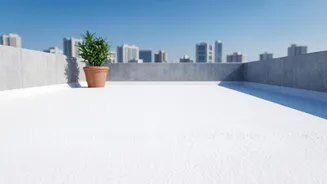
a significant amount of sunlight, converting it into heat that gets transferred inside. A conventional black roof can reach scorching temperatures, often getting much hotter than the surrounding air. Cool roofs, by contrast, are designed to do the opposite. They use materials with high solar reflectance (also called albedo) to bounce sunlight back into the atmosphere instead of absorbing it. They also have high thermal emittance, meaning they efficiently radiate away what little heat they do absorb. This one-two punch keeps the roof surface, and consequently the building beneath it, significantly cooler.
Does It Really Lower Temperatures by 5 Degrees?
The headline's claim of a five-degree reduction is not an exaggeration, but it is the upper end of a typical range. Studies and real-world projects have shown that cool roofs can lower indoor temperatures by approximately 2 to 4.5 degrees Celsius. One US Environmental Protection Agency (EPA) study cited a potential indoor temperature drop of up to 3.3°C (nearly 6°F). The exact reduction depends on various factors, including the building's insulation, ventilation, the specific type of cool roof coating used, and the local climate. While standard white paints reflect 80-90% of sunlight, newer, more advanced formulas can reflect up to 98%, with some experimental paints even cooling the surface to below the ambient air temperature. So, while five degrees represents a best-case scenario, a noticeable and significant cooling effect is well-documented.
More Than Just Cooler Rooms
The benefits of adopting white roof technology extend far beyond personal comfort. By lowering indoor temperatures, cool roofs reduce the need for energy-intensive air conditioning, leading to lower electricity bills for households and businesses. On a larger scale, this decreased energy consumption lessens the strain on the power grid, especially during peak demand in summer months. This, in turn, helps cut down on greenhouse gas emissions from power plants. Widespread adoption of cool roofs can also help mitigate the 'urban heat island' effect, where cities are significantly warmer than surrounding rural areas due to heat-absorbing roads and buildings. By reflecting sunlight, cool roofs lower the ambient temperature of entire neighbourhoods, improving public health and comfort.
Cool Roofs in the Indian Context
India is increasingly embracing cool roof technology as a practical response to its climate challenges. Following a devastating heatwave in 2010, Ahmedabad became a pioneer, implementing a Heat Action Plan that included cool roof initiatives for slum housing and government buildings. The results were tangible, with residents reporting cooler homes and better sleep. Following this success, Telangana launched India's first statewide Cool Roof Policy in 2023, mandating them for new government, commercial, and certain residential buildings. The state aims to cover 300 square kilometres with cool roofs by 2028, projecting annual electricity savings of 600 million units. Other cities are also promoting the practice through municipal plans, recognizing it as a cost-effective way to build resilience against extreme heat.
Is It Just Any White Paint?
While any light-coloured coating is better than a dark one, specialised cool roof paints and materials are engineered for maximum effectiveness. These aren't just standard decorative paints; they are formulated with specific pigments like titanium dioxide or barium sulphate that are highly reflective of the sun's rays, including non-visible UV and infrared radiation. These products are rated based on their Solar Reflectance Index (SRI), a measure of their ability to reject solar heat. Options range from liquid-applied acrylic coatings to reflective tiles and membranes. While a simple coat of lime-based wash can be effective, for long-lasting and high-performance results, it's best to look for products specifically rated and sold as 'cool roof' coatings.