



The turtle's shell is an icon of the animal kingdom, a symbol of protection and endurance. But far from being a simple house a turtle carries, it's an intricate part of its body, fused directly to the skeleton in a unique evolutionary marvel.
Not a House, But a Homebody
A common
trope in cartoons shows a turtle slipping out of its shell as if it were a piece of clothing. This popular image couldn't be further from the truth. A turtle is physically incapable of leaving its shell. That's because the shell isn’t an external object; it is an integral and living part of the turtle’s skeletal system. An empty turtle shell is only found after the animal has died and its body has decomposed, much like any other skeleton. The shell contains nerves and blood vessels, meaning a turtle can feel touch on its shell, and an injury to it can be painful and bleed, just like a broken bone.
Anatomy of an Armoured Marvel
A turtle's shell consists of two primary parts. The upper, domed section is called the carapace, while the flatter underside is the plastron. These two halves are joined on the sides by a bony structure known as the bridge. The shell itself is composed of around 50 to 60 fused bones. This bony foundation is covered by a layer of plates called scutes. These scutes are made of keratin, the same tough protein found in human fingernails and hair. The keratin scutes provide a durable, protective outer layer, and their patterns can often be used to identify different species. Some species, like softshell turtles, lack these hard scutes and instead have a leathery skin covering their bony shell.
A Ribcage Reimagined
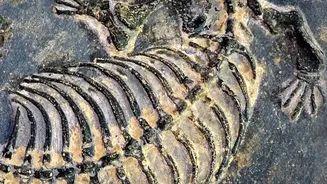
So, how is the shell actually connected to the skeleton? The answer is that the shell is a major part of the skeleton. During a turtle's development, its ribs and vertebrae broaden and grow sideways, fusing together with dermal plates in the skin to form the rigid carapace. The turtle's spine is fused directly to the inner, top part of the carapace. This means a turtle’s ribcage doesn't encircle its organs in the typical way; instead, it has become the domed roof of its shell. The plastron, or bottom shell, is primarily formed from bones related to the shoulder girdle and sternum of its ancestors. This unique arrangement is why a turtle's shoulder blades are located inside its ribcage, a feature not seen in other vertebrates.
The Evolutionary Blueprint
This incredible structure didn't appear overnight. The fossil record shows a gradual evolution over millions of years. Scientists have studied ancient turtle relatives, such as Eunotosaurus, which lived around 260 million years ago. This creature had broadened, T-shaped ribs but not a full shell, suggesting an early step in this evolutionary journey. Another transitional fossil, Odontochelys, had a fully formed plastron but lacked a complete carapace on its back, giving researchers a glimpse of a 'turtle in a half-shell'. Early theories suggested the shell evolved purely for defense, but newer research indicates the initial broadening of the ribs may have been an adaptation for burrowing, providing a stable, anchored base for powerful digging. Over time, this structure was co-opted for the incredible protection it offers today.
More Than Just a Shield
The primary function of the shell is, of course, defence against predators. Its rigidity, however, comes with a trade-off: turtles cannot expand and contract their chests to breathe. Instead, they rely on specialized muscles within the shell to actively pump air into and out of their lungs. The shell also serves other purposes. The bone provides structural support for the body and acts as a reservoir for minerals. The dark or light colouration of the keratin scutes can also play a role in thermoregulation, helping the cold-blooded animal absorb heat or reflect sunlight to manage its body temperature.