

Understanding Solar Storms
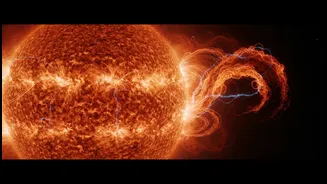
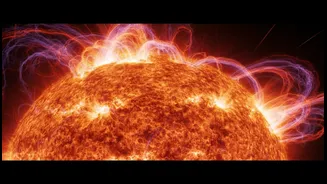
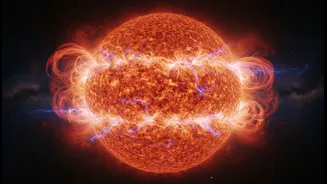
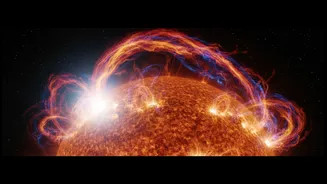
Space weather refers to the changing conditions in space driven by the Sun's activity. The most dramatic events are solar flares and coronal mass ejections (CMEs). A solar flare is an intense burst of radiation that reaches Earth in about eight minutes,
capable of causing radio blackouts. A CME is a much larger eruption, a colossal cloud of magnetised plasma and particles that travels more slowly through space. If a CME is aimed at Earth, it can trigger a geomagnetic storm, which poses the most significant threat to our modern infrastructure.
Our Technological Vulnerability
Our increasing reliance on technology makes us more susceptible to the effects of space weather. Geomagnetic storms can induce powerful electrical currents in the ground that can overload and damage power grids, potentially causing widespread blackouts. In space, the particles from a solar storm can damage sensitive satellite electronics, degrade solar panels, and alter orbits, impacting everything from GPS navigation and telecommunications to weather forecasting. This interference can disrupt aviation, shipping, and even financial transactions that depend on precise timing signals from satellites.
New Eyes on the Sun
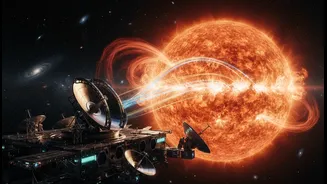
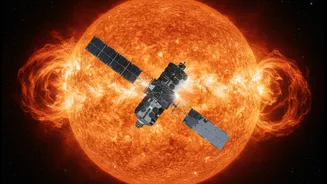
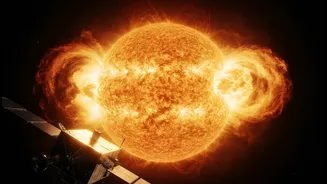
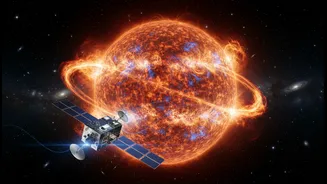
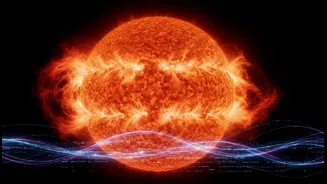
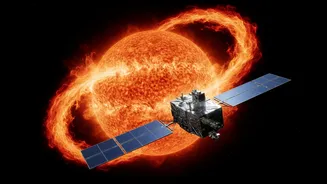
To improve our forecasts, we need better data. That's where missions like NASA's Parker Solar Probe and the European Space Agency's (ESA) Solar Orbiter come in. The Parker Solar Probe is on a daring journey to "touch the Sun," flying closer to our star than any spacecraft in history. This allows it to sample the solar wind—the stream of particles constantly flowing from the Sun—right where it originates and accelerates. The Solar Orbiter is providing the first-ever high-resolution images of the Sun's poles and is working to connect activity on the solar surface with the space weather it generates. Together, these missions provide a revolutionary view of the forces that drive solar storms.
From Raw Data to Actionable Warnings
For decades, our best warning system for an incoming CME has come from satellites positioned at a point about 1.5 million kilometres from Earth, providing only about 20 to 45 minutes of notice. The new missions are changing the game. By observing a CME as it erupts and measuring its properties far from Earth, scientists can feed this data into sophisticated computer models. For instance, by acting as an upstream monitor, Solar Orbiter has been used to test real-time forecasting, successfully predicting the arrival time and characteristics of a CME at Earth. This allows forecasters to more accurately simulate the storm's trajectory and estimate its potential severity with much greater lead time.
The Future of Space Weather Alerts
The goal is to move from short-term warnings to reliable forecasts issued days in advance. Future missions like ESA's Vigil, planned for launch around 2031, will take this even further. Positioned at a unique vantage point 'behind' Earth in its orbit, Vigil will be able to see potentially hazardous active regions on the Sun days before they rotate into a position to threaten us. This could extend the warning time for severe solar storms to four or five days. Such advanced notice would give operators of power grids, satellite networks, and other critical infrastructure invaluable time to take protective measures, safeguarding our connected world from the Sun's powerful outbursts.