




So, What Is Sonification?
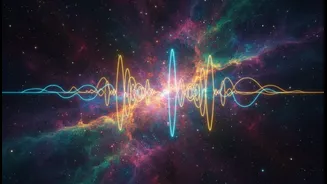
At its heart, sonification is the process of translating data into non-speech sound. Think of it as the auditory equivalent of data visualisation, where charts and graphs turn numbers into images. Instead of a bar chart, you get a melody. Instead of a scatter
plot, you get a soundscape. NASA has embraced this technique, taking the digital data collected by telescopes like the Chandra X-ray Observatory and the James Webb Space Telescope and converting it into sound. The crucial thing to remember is that this isn't what space actually sounds like. Since space is a vacuum, sound can't travel. These are translations, not recordings, designed to give us a new way to experience the universe.
How Is Space Data Turned Into Sound?
The process is both an art and a science. Scientists, often in collaboration with musicians, map different properties of the data to different aspects of sound. For instance, in an image of a galaxy, light that is brighter might be translated into a louder volume. The position of an object in the image—say, from left to right—can be mapped to the stereo field, so the sound pans from one ear to the other. Different types of light, like X-rays or infrared, can be assigned to different musical instruments—perhaps brass for X-rays and woodwinds for infrared. The pitch of a note might change based on an object's distance or the frequency of light it emits. By scanning across an image and playing these assigned sounds, a complex visual scene becomes a rich, multi-layered audio experience.
A Tool for Discovery, Not Just Outreach
While the results are often hauntingly beautiful, sonification is more than just an artistic project. It's a genuine tool for scientific analysis. The human ear is incredibly skilled at picking out patterns, variations, and anomalies that the eye might easily miss in a dense, complex dataset. This is sometimes called the 'cocktail party effect'—our ability to isolate a single voice in a noisy room. For an astronomer sifting through terabytes of data, hearing a subtle change in rhythm or an unexpected shift in pitch could signal a significant discovery, like a previously unnoticed black hole or a faint stellar explosion. It gives scientists a second, powerful sense with which to explore the cosmos and enhances their ability to analyze information.
Bringing the Cosmos to Our Ears
Beyond the lab, sonification serves a vital purpose in public engagement. It makes the abstract and distant phenomena of space feel immediate and emotionally resonant. Hearing the chaotic crescendo of a supernova remnant or the delicate notes of a star-forming region creates a connection that an image alone might not. Crucially, it also makes astronomy dramatically more accessible to people who are blind or have low vision. By translating visual data into a sensory experience that doesn't rely on sight, NASA opens up the wonders of the universe to a much wider audience, allowing more people to participate in the journey of discovery.
Where Can You Hear the Universe?
NASA has made a wealth of sonified data available to the public. The primary home for many of these projects is the website for the Chandra X-ray Observatory, which has a dedicated 'A Universe of Sound' section. There, you can listen to compositions based on data from the Galactic Center, the Pillars of Creation, the Crab Nebula, and many more cosmic landmarks. These tracks, often presented as videos that show the image being scanned as the sound plays, can also be found on NASA's YouTube channels and streaming service, NASA+. Exploring these resources offers a unique opportunity to listen to the data behind the spectacular images we've come to love, providing a completely new appreciation for the complexity and beauty of our universe.