




The Sun’s Unpredictable Fury
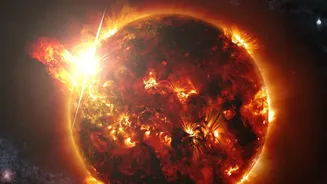
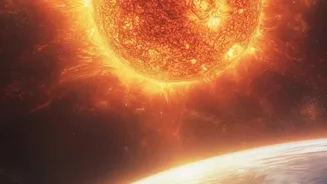
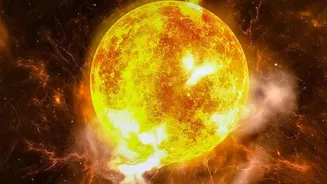
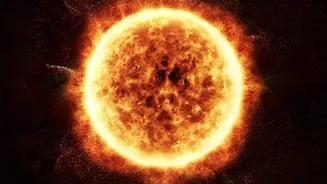
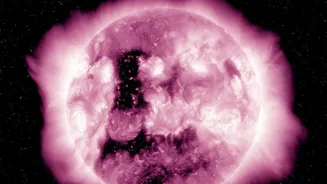
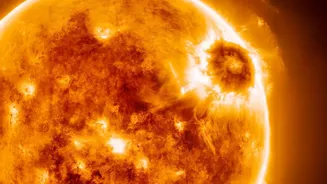
Our sun is not always the benign star it appears to be. It regularly ejects billions of tons of magnetized plasma in events called coronal mass ejections (CMEs), or solar storms. While most miss Earth, a direct hit poses a significant threat to our technologically
dependent civilization. These storms can induce powerful electrical currents in our planet's magnetic field. In a world run by electronics, the consequences could be catastrophic. The historical benchmark is the 1859 Carrington Event, a solar superstorm that caused telegraph systems worldwide to spark, shock operators, and even set paper ablaze. Auroras were visible as far south as the Caribbean. If a storm of that magnitude occurred today, it could cause widespread, long-lasting blackouts, disable GPS and communication satellites, and disrupt everything from financial transactions to emergency services.
The Challenge of Predicting Chaos
For decades, predicting when and where a solar storm will strike has been a monumental challenge. Scientists can observe CMEs as they leave the sun, but tracking their path and predicting their earthly impact is notoriously difficult. A CME can take one to three days to travel to Earth, but until recently, forecasters could only provide a few hours of general warning before its arrival. This limited timeframe made it difficult for power grid operators, satellite controllers, and airlines to take meaningful protective action. The warnings were often global and lacked the specific, regional detail needed to respond effectively. The problem wasn't a lack of data, but the inability to process the complex variables of the solar wind and Earth's magnetic field in time to make a useful prediction.
Enter DAGGER: An AI Shield
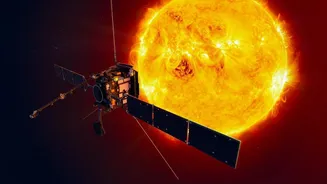
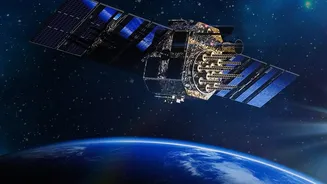
This is where NASA's new research offers a breakthrough. An international team of scientists has developed a computer model called DAGGER, which stands for Deep Learning Geomagnetic Perturbation. Instead of relying on complex, time-consuming physics models, DAGGER uses artificial intelligence to find patterns in vast amounts of data. The AI was trained on information from numerous heliophysics missions that have studied the solar wind for years, and it learned to connect specific changes in the solar wind to geomagnetic disturbances recorded at ground stations on Earth. By analyzing live data from satellites positioned between the sun and Earth, DAGGER can predict the specific effects of an incoming storm with astonishing speed.
A Critical 30-Minute Warning
The key advantage of DAGGER is its speed and specificity. The AI model can provide a forecast for a specific location on Earth with a 30-minute warning before the storm's impact. This is a game-changer. While half an hour may not sound like much, for critical infrastructure operators, it's a vital window of opportunity. The model produces predictions in less than a second and updates them every minute, offering a real-time alert system. According to Vishal Upendran, the lead author of the paper on the model, this allows for rapid and accurate global predictions that can inform decisions to minimize or even prevent devastation. The system's effectiveness was validated by testing it against data from past geomagnetic storms that occurred in 2011 and 2015.
What This Means for Life on Earth
A 30-minute warning allows for concrete actions that can safeguard our infrastructure. Power companies can have time to reroute power or temporarily take sensitive transformers offline to prevent them from overloading and burning out. Satellite operators can command their spacecraft to enter a protective safe mode, orienting them to minimize damage from high-energy particles. Airlines flying polar routes, which are more exposed to space radiation and communication blackouts during storms, can be rerouted. The computer code for DAGGER is also open-source, meaning companies and utility providers can adopt and integrate this technology into their own operations, creating a global network of planetary defence against the sun's fury. It’s akin to having a tornado siren for space weather, allowing us to brace for impact.