





What Exactly Is This Anomaly?
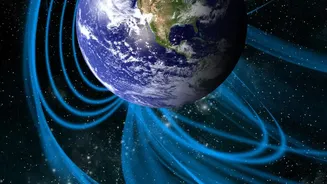
The South Atlantic Anomaly (SAA) is a huge region stretching from South America to southwestern Africa where Earth's magnetic field is significantly weaker than anywhere else. NASA has described it as a 'pothole in space'. In this area, the inner Van
Allen radiation belt — a zone of energetic charged particles trapped by our planet's magnetism — dips much closer to the surface, down to an altitude of just 200 kilometres. This means that the shield is thinner here, allowing high-energy particles from the Sun and cosmic rays to penetrate deeper into Earth's upper atmosphere.
The Deep Earth Origins
The anomaly isn't caused by something in the atmosphere, but by the chaotic processes happening deep within our planet. Earth's magnetic field is generated by the churning ocean of molten iron in its outer core, roughly 3,000 kilometres below the surface. This acts like a massive generator, or geodynamo. However, the field isn't perfectly symmetrical like a simple bar magnet. For one, Earth's magnetic axis is tilted. Secondly, the flow of molten metal in the core is not uniform. Scientists believe a massive, dense rock formation under the African continent, known as a large low-shear-velocity province, disrupts this flow. This interference creates localised areas where the magnetic field's polarity is reversed, weakening the overall strength of the field in the region above.
A Growing Concern for Technology
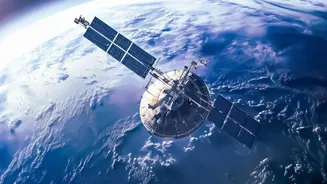
While you won't feel the SAA on the ground, its effects are significant for objects orbiting above. Satellites passing through the anomaly are bombarded with a higher dose of radiation. These high-energy particles can disrupt electronics, causing glitches known as 'single event upsets', data corruption, or even permanent hardware damage. To avoid this, operators of crucial assets like the International Space Station and the Hubble Space Telescope often power down non-essential or sensitive instruments when passing through the region. Even laptops on the Space Shuttle have been known to crash inside the anomaly. Recent data from the European Space Agency's (ESA) Swarm satellites show the anomaly is not only expanding—growing by an area nearly half the size of Europe since 2014—but is also splitting into two distinct lobes, creating new challenges for satellite missions.
Is It Dangerous for People on Earth?
The short answer is no. The magnetic field at ground level, even within the SAA, remains strong enough to protect all life on the surface from harmful space radiation. The atmosphere provides an additional, very effective layer of shielding. The concerns are focused on our technological infrastructure in low-Earth orbit. While the anomaly influences systems like GPS and radio communications that rely on stable magnetic field data, these are technical challenges for engineers, not direct threats to human health. Some have wondered if the growing anomaly signals an impending reversal of Earth's magnetic poles, but geological records show similar weak-field episodes have occurred many times in the past without triggering such an event.
Monitoring the Shifting Shield
Scientists at global agencies like NASA and the ESA are continuously monitoring the SAA. Using data from satellite constellations like Swarm, they can create detailed maps of the anomaly's evolution. Researchers have observed that the anomaly is drifting westward and that the weakening has become more intense in a region southwest of Africa since 2020. Understanding how and why the SAA changes is crucial. This knowledge helps engineers design more robust satellites with better radiation shielding and allows mission operators to plan spacecraft trajectories to minimise exposure, safeguarding the orbital technology that has become essential to our modern world.