


A New Cosmic Vista
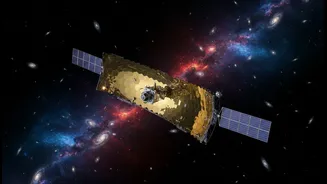
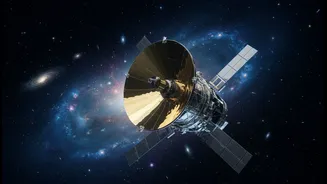
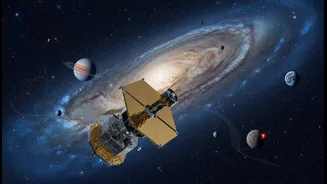
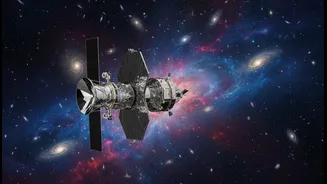
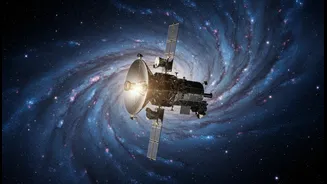
The Nancy Grace Roman Space Telescope, named after NASA’s first chief of astronomy, is the next great observatory in the agency’s lineup. While its primary mirror is the same size as the Hubble Space Telescope's, its power lies in its extraordinary field
of view. Its Wide Field Instrument can capture an area of the sky at least 100 times larger than Hubble in a single shot. This means that where Hubble provides a detailed portrait of a single galaxy, Roman will deliver a sprawling group photo of thousands. This ability to survey huge cosmic areas quickly will transform how scientists tackle the universe's biggest mysteries.
Illuminating the Dark Universe
About 95% of the universe is made of dark matter and dark energy, mysterious components we can't see or directly detect. Roman is designed to hunt for their effects across the cosmos. It will map the structure of the universe by observing how the light from hundreds of millions of galaxies is bent by the gravity of unseen dark matter, a technique called weak gravitational lensing. By studying how the universe's expansion has changed over billions of years, driven by dark energy, Roman will provide crucial data to help scientists understand these dominant, invisible forces that shape our reality.
A Galactic Planet Census
How common are planets in our galaxy? Roman will conduct a massive survey to find out, using a clever method called gravitational microlensing. This technique looks for a brief, temporary brightening of a distant star, which happens when a closer, unseen object—like a planet and its star—drifts in front of it, its gravity acting as a lens. This method is sensitive enough to find planets of all sizes, from gas giants down to worlds smaller than Earth. It will even be able to detect rogue planets, which wander through the galaxy without a host star. Scientists expect Roman to discover thousands of new worlds, providing a statistical treasure trove of planetary systems.
Taking the First Direct Portraits
While finding planets is one thing, seeing them is another. Planets are incredibly faint next to their blazing stars. Roman is equipped with a technology demonstration called a Coronagraph Instrument, an advanced system of masks and mirrors designed to block starlight. This will allow the telescope to take direct images of large, Jupiter-like planets orbiting nearby stars. The coronagraph is 100 to 1,000 times more powerful than previous space-based versions. While its main goal is to prove the technology for future missions, it will give us our first direct look at the light from these distant worlds and even analyze their atmospheres.
The Next Chapter in Cosmic Discovery
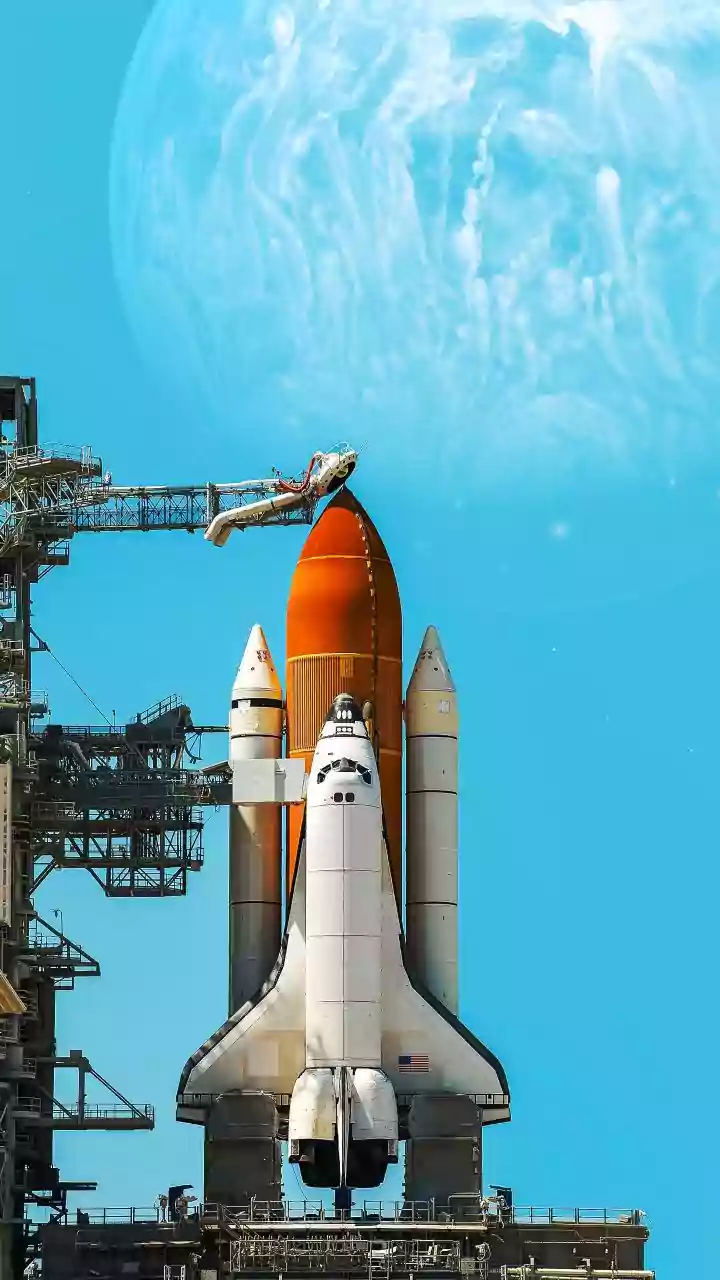
Scheduled to launch by late 2026, the Roman Space Telescope will operate from a stable orbit about 1.5 million kilometers from Earth. Over its five-year primary mission, it is expected to generate an unprecedented amount of data—around 20 petabytes, which is more than all of Hubble's data combined. By creating vast maps of the cosmos and a new catalogue of alien worlds, Roman won't just provide answers; it will generate new questions for a new generation of scientists. It represents a shift from focused snapshots to creating a sweeping motion picture of the evolving universe, empowering everyone with a clearer, grander perspective on our place within it.