


The Problem with 'Good Enough' Batteries
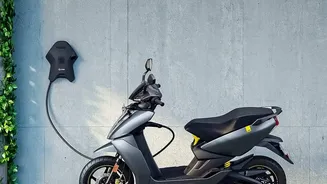
For years, the electric vehicle world has been dominated by lithium-ion batteries. They're in our phones, laptops, and the electric scooters zipping through our cities. Their formula is proven: lithium ions shuttle between a cathode and a graphite anode
to store and release energy. But this reliable workhorse has an Achilles' heel when it comes to speed. Try to charge a standard lithium-ion battery too quickly, and you run into a problem called 'lithium plating'. Instead of neatly slotting into the graphite anode, lithium ions essentially get stuck on the surface, forming metallic dendrites. This not only reduces the battery's capacity and lifespan but also creates a serious safety risk. To avoid this, charging speeds are deliberately limited, leading to the four-to-eight-hour waits that scooter owners know all too well. This charging delay has been a fundamental barrier to making e-scooters a truly spontaneous and convenient alternative to their petrol-powered cousins.
The Silicon Anode Revolution
The key to unlocking faster charging lies in redesigning the anode. Several companies are now pioneering the use of silicon to replace graphite. Silicon is a battery superstar in the making because it has a much greater capacity for storing lithium ions—up to ten times more than graphite. This means more energy can be packed into a smaller space. More importantly for fast charging, it allows ions to be absorbed more quickly without the plating risk that plagues graphite. Companies like the Israeli firm StoreDot are at the forefront, developing silicon-dominant batteries for what they call 'extreme fast charging' (XFC). StoreDot has demonstrated its technology by fully charging an electric scooter in just five minutes. Their innovation involves using proprietary organic and inorganic compounds to manage silicon's main drawback: its tendency to swell and shrink during charging and discharging, which can physically break down the battery over time. By solving this stability puzzle, silicon anodes are making 10-minute charging a viable commercial goal.
Exploring Other Chemical Pathways
Silicon isn't the only material shaking up the battery world. UK-based Echion Technologies is championing niobium-based anodes. Their XNO® anode material enables a full, safe charge in as little as six minutes while offering an exceptionally long cycle life, potentially lasting for over 10,000 cycles with minimal degradation. This technology is particularly suited for heavy-duty industrial vehicles but is now being commercialised for wider applications. Another alternative is lithium-titanate (LTO) batteries, which have been used in industrial settings for years. A startup called Zapbatt created a system that makes LTO batteries from Toshiba viable for consumer products like e-bikes, offering a potential full charge in 10-15 minutes with extreme safety and a lifespan that could exceed 20 years. These different chemistries prove there isn't just one path to ultra-fast charging; a new era of material science is providing multiple solutions to the same core problem.
Solid-State: The Next Frontier
Perhaps the most anticipated breakthrough is the solid-state battery. These batteries replace the liquid electrolyte found in conventional lithium-ion cells with a solid material, like a ceramic or polymer. This fundamental change offers a triple-threat of benefits: higher energy density (meaning more range), greatly improved safety by removing flammable liquids, and the ability to handle very high charging currents. Several companies are racing to bring them to market. While Toyota targets 2027 for cars, two-wheeler applications are appearing even sooner. Verge Motorcycles, for instance, announced it would be the first to deliver production motorcycles with solid-state batteries, enabling a charge time of around 10 minutes for significant range. For scooters, Taiwan's Gogoro, famous for its battery-swapping network, has partnered with ProLogium to develop a swappable solid-state battery prototype which is expected to hold significantly more energy than its current models.
The Roadblocks to a Ten-Minute Future
While the technology is rapidly advancing in labs and prototypes, a few hurdles remain before you can get a 10-minute charge at every corner. First, there's cost. Many of these new materials and manufacturing processes are currently more expensive than traditional lithium-ion production. Second is infrastructure. Ultra-fast charging requires powerful DC charging stations, not a simple wall outlet. Building out a public network of these chargers is essential. Finally, there's the question of real-world battery health. While companies tout impressive cycle life in lab tests, ensuring these batteries can withstand years of abuse—from rough roads to extreme temperatures—is the final piece of the puzzle. Indian scooter maker Ather, for example, notes that while its public fast-charging network is useful, slower home charging is often better for long-term battery health with current technologies. The new formulations from StoreDot, Echion, and others aim to eliminate this trade-off entirely.