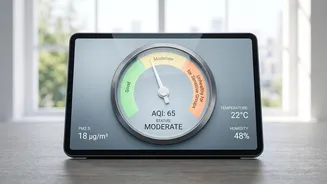







Every day, we see numbers for air quality, but what do they really mean? An AQI of 350 sounds bad, but how bad is it? This guide will demystify PM2.5 and the Air Quality Index so you can make sense of the data and protect your health.
Decoding PM2.5: The Invisible Threat
The term you hear
most often with air pollution is PM2.5. It stands for Particulate Matter that is 2.5 micrometres or smaller in diameter—about 30 times smaller than a single human hair. These fine particles come from sources like vehicle exhaust, industrial emissions, construction dust, and the burning of waste or wood. Because they are so incredibly small and light, they stay suspended in the air for longer. Their size is precisely what makes them so dangerous. Unlike larger dust particles (like PM10) that get trapped in your nose and throat, PM2.5 particles can travel deep into your lungs and even pass into your bloodstream. Once in the bloodstream, they can cause inflammation and contribute to a host of health problems, including respiratory infections, heart disease, and aggravated asthma. There is no known safe level of exposure; the lower the concentration, the better.
The AQI: Your Daily Air Quality Scorecard
While PM2.5 is a major concern, it's not the only pollutant out there. To make things simpler, government agencies use an Air Quality Index, or AQI. Think of it as a scorecard that converts complex data from multiple pollutants into a single, easy-to-understand number. In India, the National Air Quality Index (NAQI) was launched in 2014 by the Central Pollution Control Board (CPCB). It tracks eight key pollutants: PM2.5, PM10, nitrogen dioxide (NO₂), sulphur dioxide (SO₂), carbon monoxide (CO), ozone (O₃), ammonia (NH₃), and lead (Pb). The final AQI number you see on an app or news report isn't an average of all these pollutants. Instead, it is determined by the pollutant with the highest reading at that time. In most Indian cities, especially during pollution season, PM2.5 is the dominant pollutant that drives the final AQI score.
Good to Severe: What the Colours Mean
India's AQI runs on a scale from 0 to 500 and is divided into six colour-coded categories to help you quickly assess the risk. Here's a breakdown of the official CPCB categories:
Good (0–50, Green): The air quality is considered safe with minimal health impact.
Satisfactory (51–100, Light Green): Generally acceptable, but sensitive individuals may experience minor breathing discomfort.
Moderate (101–200, Yellow): This can cause breathing discomfort for people with existing lung or heart conditions, children, and older adults.
Poor (201–300, Orange): Most people may begin to experience breathing discomfort with prolonged exposure.
Very Poor (301–400, Red): This level can lead to respiratory illness after prolonged exposure. The health risks become more serious for everyone.
Severe (401–500+, Maroon): The air is hazardous. It affects even healthy people and seriously impacts those with existing diseases.
Practical Steps to Protect Yourself
Understanding the categories is the first step; taking action is the next. Your response should adapt to the daily reading. In the 'Good' and 'Satisfactory' ranges, outdoor activity is generally safe for most people. As the AQI enters the 'Moderate' category, sensitive groups—like children, the elderly, and anyone with heart or lung conditions—should reduce prolonged or heavy outdoor exertion. When the AQI is 'Poor' (201-300), everyone should avoid strenuous outdoor activities like running. If you must go out, consider wearing a certified N95 or N99 mask, as simple cloth or surgical masks do not effectively filter out PM2.5 particles. For 'Very Poor' and 'Severe' days, the advice is stricter: minimize all outdoor activity if possible. Keep windows and doors closed to prevent polluted air from entering your home. Using a high-quality air purifier indoors can also significantly reduce your exposure to harmful particles. Stay hydrated and eat a diet rich in antioxidants, like fruits and leafy vegetables, to help your body combat the inflammatory effects of pollution.