




Meet CHIME: A Telescope Like No Other
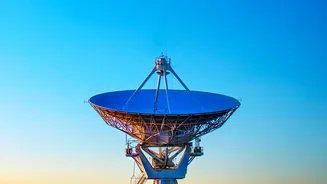
Unlike traditional telescopes that use large, steerable dishes, CHIME consists of four stationary, 100-metre-long half-pipe cylinders. It has no moving parts and instead uses the Earth's rotation to scan the entire northern sky every single day. This
innovative design makes it exceptionally good at what it was built for: mapping the faint radio signals from neutral hydrogen, the most abundant element in the cosmos. By capturing these signals, CHIME aims to create a vast three-dimensional map of the universe, offering clues to one of physics' biggest puzzles.
The Quest to Understand Dark Energy
One of the most profound mysteries in modern science is why the universe's expansion is accelerating. Scientists attribute this phenomenon to a mysterious force called 'dark energy,' but its nature remains unknown. To understand dark energy, cosmologists need to measure the expansion history of the universe with incredible precision. This is where hydrogen comes in. Hydrogen gas acts as a cosmic tracer, revealing how matter was distributed billions of years ago. By mapping this ancient hydrogen, scientists can track how the universe expanded over time and test competing theories about what dark energy is.
The Breakthrough: A Standalone Measurement
In a milestone achievement reported in late 2026, the CHIME collaboration announced it had successfully detected the faint glow of hydrogen from when the universe was about five billion years old. What makes this demonstration so significant is that it was achieved using only CHIME's own data, a technique called auto-correlation. Previously, such faint signals had to be confirmed by cross-correlating them with data from other, more expensive optical telescopes that map individual galaxies. Proving this standalone method works is a game-changer; it shows that CHIME can independently and cost-effectively map huge volumes of the universe.
What Did the Data Actually Show?
The research, based on 94 nights of observation in 2019, successfully filtered out immense background noise from our own galaxy and human-made interference to isolate the faint hydrogen signal. The analysis revealed the statistical clustering of hydrogen gas at a time when the universe was less than half its current age. This doesn't yet provide a definitive measurement of dark energy itself. Instead, it serves as a crucial 'proof of concept'. It demonstrates that the technique, known as hydrogen intensity mapping, is a viable and powerful new tool for probing the cosmos and its evolution.
Why This Demonstration Matters for Science
The success of CHIME's hydrogen mapping opens a new, cost-effective window onto the early universe. Traditional galaxy surveys are time-consuming and can only see the bright, dense regions where stars have formed. Intensity mapping, by contrast, measures the combined glow of all hydrogen, including from dimmer, more diffuse areas, giving a more complete picture of cosmic structure. This allows scientists to map larger areas of the sky, peer further back in time, and gather data much faster. CHIME has essentially validated a completely new and independent method for investigating the universe's expansion history.